
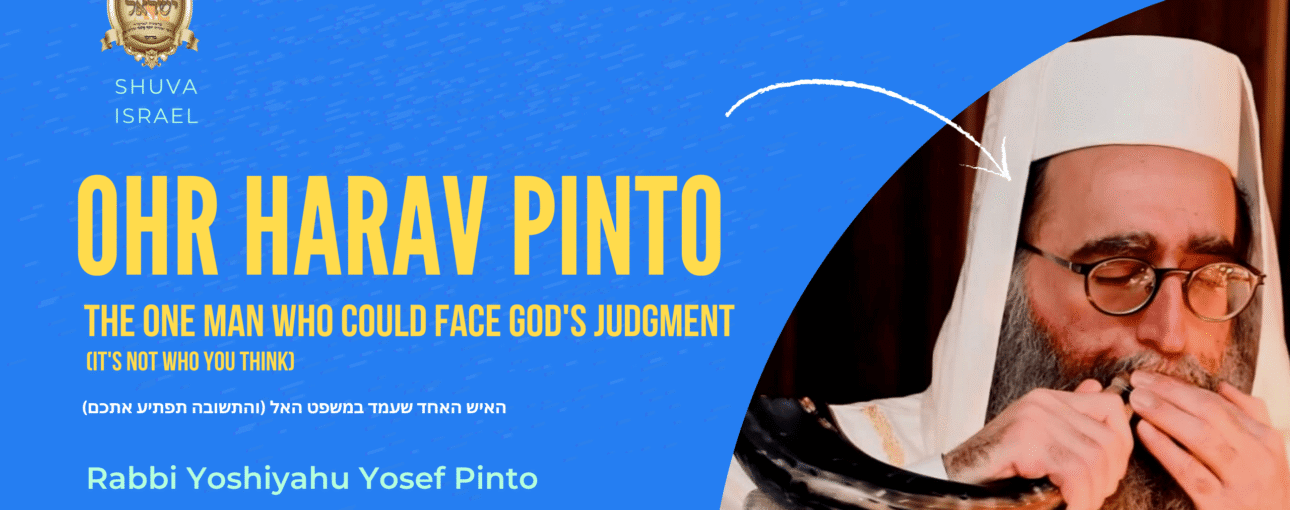
The Only Man Who Could Face G*d’s Judgment: Unraveling the Mystical Secret of Moshes’ Name and the Crying Waters of Creation
A profound teaching from Rabbi Yoshiyahu Pinto
Have you ever considered the sheer, incomprehensible greatness of Moshe Rabbeinu (Moses, our teacher)? We know him as the lawgiver, the prophet, the faithful shepherd. But what if his true stature is something so immense that it transcends our very ability to grasp it?
What if I told you that according to the holy Sages, not even the patriarchs Abraham, Isaac, and Jacob could have withstood the pure, unfiltered judgment of G*d? And that the key to understanding this unique power lies hidden in a name given not by a prophet or a sage, but by an Egyptian princess, the daughter of the tyrannical Pharaoh?
In a recent soul-stirring shiur, Rabbi Yoshiyahu Pinto unveiled a stunning tapestry of interconnected secrets, weaving together the identity of Moshe Rabbeinu, the ecstatic joy of the Sukkot holiday, and a cosmic dispute from the second day of creation. This is not just a lesson; it is a journey to the very foundation of the world.
The Man of G*d: The Only Soul Who Could Endure Divine Judgment
Rabbi Pinto begins by citing the holy Or HaChaim on the Torah portion V’Zot HaBracha. The Or HaChaim makes a statement that is nothing short of staggering: of all human beings who have ever lived, only one could stand before the Almighty in pure judgment (Mishpat) and emerge vindicated.
That one man was Moshe Rabbeinu.
This is a concept that challenges our understanding. We think of the towering spiritual giants:
-
Avraham Avinu (Abraham), who single-handedly discovered monotheism and was willing to sacrifice his own son.
-
Yitzchak Avinu (Isaac), who embodied pure strength and self-sacrifice.
-
Yaakov Avinu (Jacob), who wrestled with an angel and fathered the twelve tribes of Israel.
-
King David, the “sweet singer of Israel,” whose psalms are the eternal cry of the Jewish soul to God.
Yet, as Rabbi Pinto explains, even these holy of holies could not have passed the attribute of absolute judgment. King David himself pleads in Psalms (143:2), “Do not bring Your servant into judgment, for no living being will be justified before You.”
Only Moshe could. This is why the Torah gives him the unique title “Ish HaElokim” — “the Man of G*d.” The name “Elokim” represents God’s attribute of strict judgment (Din). Moshe was the man who could stand in the full, unblinking light of that attribute and be found whole. His spiritual composition was so pure, so perfectly aligned with the Divine will, that no flaw could be found.
This establishes his unparalleled status. But it also deepens a profound mystery.
The Profound Paradox: Why Is Moses Known by a Pagan Name?
If Moshe’s essence is so uniquely holy, why do we call him by the name he was given in Pharaoh’s palace?
Let us revisit the well-known story. His mother, Yocheved, hides him for three months. To save him from the decree to kill all male Hebrew infants, she places him in a small ark on the Nile River. Bithiah (Batya), the daughter of Pharaoh, discovers him. She recognizes him as a Hebrew child, has mercy, and adopts him.
She names him Moshe, “for from the water I drew him” (ki min hamayim meshitihu).
The Talmud teaches that Moses had many other names—ten, in fact. His parents called him Tov (“Good”). Why did this name, given by an idol-worshipping princess, become his eternal name? The name by which God Himself addresses him? The name enshrined forever in the verse, “Remember the Torah of Moshe, My servant”?
This isn’t a historical accident. It is a Divine secret. The answer, Rabbi Pinto reveals, lies not on the banks of the Nile, but in the joyous celebrations of Sukkot in the Holy Temple in Jerusalem.
The Ecstatic Joy of Water: Simchat Beit HaShoeva
The holiday of Sukkot is commanded to be a time of ultimate joy. The Torah states, “You shall rejoice in your festival… and you shall be only joyful” (v’hayita ach sameach). The Vilna Gaon teaches that the most difficult mitzvah in the entire Torah is to maintain this state of pure joy for all seven days of Sukkot.
During the time of the Temple, this joy reached its apex during the nightly celebration of Simchat Beit HaShoeva — the Celebration of the Water-Drawing. The Talmud describes a scene of ecstatic celebration that is hard for us to imagine:
-
The greatest sages, leaders of the Sanhedrin, would dance all night.
-
Rabban Gamliel, the Nasi (prince) of Israel, would juggle eight flaming torches. He would then perform a physical feat of incredible balance, suspending his entire body in the air while standing only on his two big toes.
-
The joy was so intense and spiritually potent that the Talmud states that one could draw Ruach HaKodesh (Divine Inspiration or prophecy) from it. The prophet Jonah, we are told, received his prophecy from the joy of this celebration.
What was the source of this unparalleled spiritual ecstasy? A simple ceremony: the Nisuch HaMayim, or the water libation. Once a year, on Sukkot, they would draw living water from the Shiloach spring, bring it to the Temple amidst song and dance, and pour it onto the altar.
Wine was poured on the altar daily. But water, just once a year. Why did this simple act of pouring water unleash such a torrent of cosmic joy and Divine light?
The Cosmic Secret: The Crying Waters of Creation
To understand this, Rabbi Pinto takes us back to the very beginning. On the second day of Creation, God separated the “upper waters” (the heavens) from the “lower waters” (the seas and oceans).
The Sages teach that on this day, the Torah does not say, “and it was good.” Why? Because conflict entered the world. The lower waters began to cry and complain to God. “Why are we not close to our King?” they lamented. They yearned to be near the Divine presence like the upper waters.
This primordial sorrow of the lower waters is an ongoing spiritual reality.
-
The waves of the sea are a physical manifestation of the water’s constant desire to rise up and reunite with its source above.
-
The salt in the ocean, the Sages teach, is the crystallization of the water’s tears.
God, the Cause of all causes, made this division for a purpose beyond our understanding. But He also made a promise to the lower waters to pacify them. He told them:
-
Your “tears” will have a place of honor: “Every offering will be salted with salt.”
-
Once a year, during the festival of Sukkot, you will be elevated. Your very essence will be taken from a spring of living water and placed upon the holy altar in the Temple, reuniting you, symbolically, with the upper waters.
The Simchat Beit HaShoeva was therefore not just a celebration. It was the annual healing of a cosmic wound from the dawn of time. It was the moment the dispute was resolved, when the lower was elevated to the upper, creating a unification that released a wave of indescribable joy and holiness throughout the world.
The Grand Unification: Moses, the Man Drawn from Water
Now, all the pieces click into place.
The joy of Sukkot comes from healing the division of the waters.
The prophecy of Jonah comes from the joy of the water libation.
The holiest ceremony of the most joyous festival revolves around unifying the lower and upper waters.
And who is the man chosen to lead the Jewish people, to bring the Torah from heaven (the upper realm) down to earth (the lower realm)? Who is the ultimate connector between God and humanity?
It is Moshe. A man whose very name means “drawn from the water.”
God did not choose the name Tov. He chose the name Moshe because it defines his ultimate soul mission. Moshe Rabbeinu is the human embodiment of the healing of the waters. He is the bridge. He unites the physical and the spiritual, heaven and earth, God and Israel. His entire being is the resolution of that primordial conflict.
This is why his name, which came from the “lower waters” of the Nile River in Egypt, was the perfect name for the man who would ascend to the “upper waters” of the heavens to receive the Torah.
Bringing the Light Into Our Lives
This teaching transforms our understanding of Moshe, Sukkot, and even creation itself. It reminds us that every detail in the Torah is infinitely deep and purposeful.
The suffering we endure on Yom Kippur purifies us for the year. The joy we experience on Sukkot, especially when we connect to its inner dimension of unity, elevates us and can bring us Divine inspiration. And remembering Moshe Rabbeinu—the man whose name signifies the healing of cosmic separation—gives us the strength to bridge the gaps in our own lives, to connect our daily actions to our higher purpose, and to unite ourselves with the will of our Creator.
May we all merit, in the power of the Faithful Shepherd, Moshe Rabbeinu, to draw from these holy days a great light, immense success, and a joy so profound that it heals our souls and the entire world.
