
High Holiday Spiritual Preparation
The Cosmic Trial: Why the Angels Disputed Your Creation
🎥 Watch the Full Lesson
🎧 Listen on the Podcast
As the sun begins to dip below the horizon on the eve of Rosh Hashanah, the atmosphere of the world shifts. We leave behind the mundane chatter of the marketplace and enter a state of deep, soul-searching introspection. We stand at the threshold of the New Year, but more importantly, we stand at the threshold of the Heavenly Court. In a powerful and urgent discourse, Rabbi Yoshiyahu Yosef Pinto, Shlita, challenges us to look beyond the rituals of the holiday and understand the terrifying, beautiful reality of our existence.
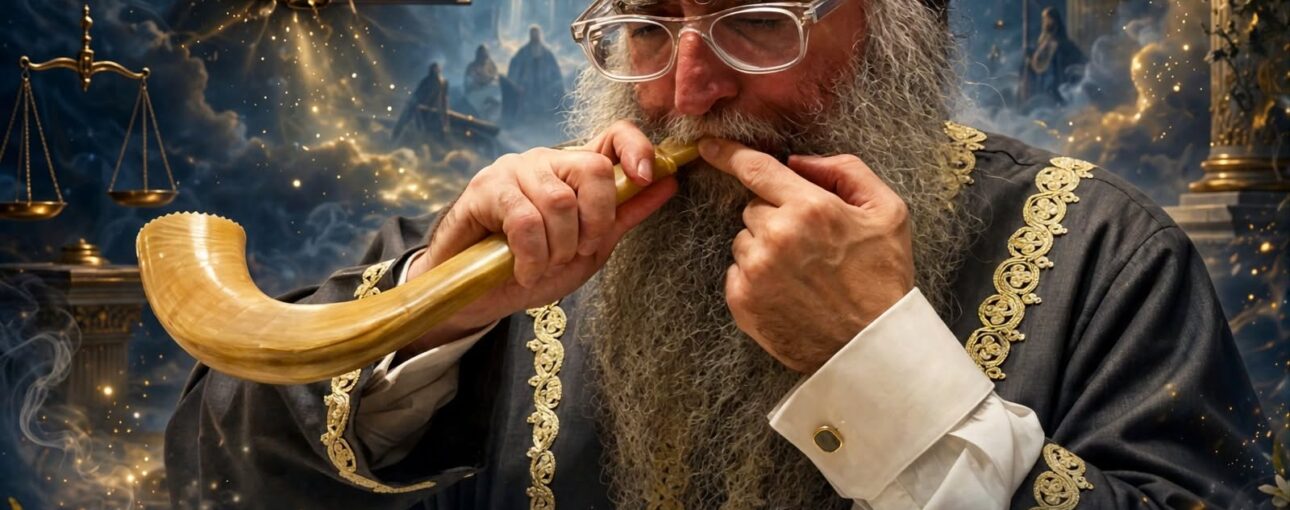
The Mystery of the Shofar: The Law of Intention
Rabbi Yoshiyahu Yosef Pinto, Shlita, begins with a deep exploration of Jewish Law (Halakha) through the lens of the Rambam. Why is the Mitzvah of Shofar different from all others? The Rambam rules that if someone is forced to eat Matzah on Passover—even if against their will—they have fulfilled the obligation. The physical act of eating is sufficient. However, when it comes to the Shofar, the law changes. If you hear the sound but do not *intend* to fulfill the obligation, you have done nothing.
The Rabbi explains that this distinction reveals the very essence of Rosh Hashanah. The day is not about a physical action; it is about the “Hearing of the Soul.” As the Beit Halevi states, the blessing we recite is not “to blow the Shofar,” but “to hear the sound of the Shofar.” Hearing requires a vessel. It requires an internal opening. Without intention, the sound is merely noise. With intention, it becomes a spiritual resuscitation that reaches the very root of a person’s soul.
The Cosmic Trial: The Angels’ War Over Your Life
Before G-d created the first man, a cosmic debate erupted in the heavens. Rabbi Yoshiyahu Yosef Pinto, Shlita, brings a Midrash that should make every human being tremble. The ministering angels formed into warring groups. Kindness and Justice argued that Man should be created, for he would perform acts of charity and righteousness. But Truth and Peace cried out, “Do not create him! For he is entirely full of lies and strife.”
This was not a historical event; it is a recurring reality. The Rabbi teaches that every Rosh Hashanah, this debate is reopened. We are being judged: Does the truth of our lives outweigh the lies we tell every three minutes? Does our kindness outweigh the conflicts we foster with our family, friends, and business partners? We run through life like a horse charging into battle, never stopping to think about ourselves. Rosh Hashanah is the moment the horse is pulled back, and we must prove to the Angels of Truth that we are worthy of another year of life.
G-d’s Mouth-to-Mouth Resuscitation
The Rabbi reveals a deep mystical secret: the Shofar is the “recycling” of the first breath of life. When G-d created Adam on the first of Tishrei, He breathed into his nostrils the breath of life. That breath was the original Shofar blast. On Rosh Hashanah, we are asking G-d to perform spiritual mouth-to-mouth resuscitation on us. Over the year, our souls become covered in dust—the dust of sin, the dust of ego, and the dust of confusion. The sound of the Shofar is designed to ignite the spark that has gone out inside us and clear away the debris of a year spent in spiritual slumber.
The Frightening Calculation: Why the Wicked Prosper
One of the most difficult questions in theology is why the wicked often live in peace while the righteous suffer. Rabbi Yoshiyahu Yosef Pinto, Shlita, brings a chilling explanation from the Ramban (Nachmanides). G-d is a perfect Judge. If a wicked person has performed even one great Mitzvah, G-d may reward them entirely in *this* world, giving them health and wealth now so they have nothing left in the World to Come. Conversely, a righteous person may be written for “death” or suffering to atone for a single sin, ensuring their portion in eternity is perfect.
“A person does not know what will stand with them in the future. What good deed they have done, what self-sacrifice they have made—that is what will stand with them in judgment. One Mitzvah can tip the scale for the entire world toward salvation.”
This teaching strips us of our complacency. We cannot look at our bank accounts or our comfort and assume we are “winning” the trial. The only true security lies in our connection to G-d, our Torah study, and our acts of self-sacrifice.
The Three Keys to the Extension: Repentance, Prayer, and Charity
If the judgment is so rigorous, how do we survive? The Rabbi teaches that we are looking for an “extension.”
- Teshuva (Repentance): It is like breaking a glass and telling the owner, “I will pay you later.” It acknowledges the debt and stops the conflict.
- Tefillah (Prayer): It is the breaking of the heart that pleads for more time from the King.
- Tzedakah (Charity): This is the most practical key. When you give from your own hard-earned money, you are giving a piece of your life. G-d sees this and responds by giving you a piece of His life.
Breaking the Cycle of Poverty
A specific secret shared in this lesson is the protection of future generations. The Rabbi notes that poverty often strikes every family once every three generations. By giving charity during these exalted days, we should have the intention that our generosity acts as a shield, ensuring that our children and grandchildren are protected from financial and spiritual lack.
The Legacy of Shuva Israel
Rabbi Yoshiyahu Yosef Pinto, Shlita, concludes with a moving testimony to the community of Shuva Israel. He notes that in Ashdod and across the globe, the light of Torah and kindness is reaching new heights. He testifies that every penny given to the poor under the supervision of the Pinto family goes directly to those in need. This purity of charity is what stands as a defense attorney for the people of Israel on the Day of Judgment.
We are entering Rosh Hashanah. Let us not enter it on “autopilot.” Let us search our ways, return to G-d, and prepare our vessels so that the blessings of the New Year can finally find a home within us.
