
THE TALK OF THE TOWN
ANNALS OF RELIGION
THE PAGE AND THE ANGEL
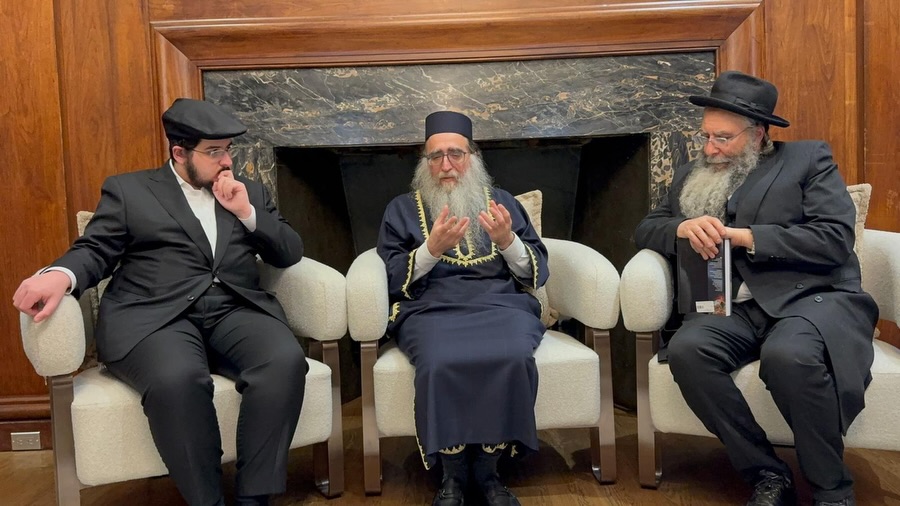
In the quiet, pressurized atmosphere of a room where ancient lineage meets modern displacement, Rabbi Yoshiyahu Pinto recently received a delegation from the Yavne Yeshiva of Montreal. They had come from the land of the Saint Lawrence River—a group of sixth graders, their educators, and the various stewards of the community’s spiritual architecture—to sit before a man whose family tree is less a list of names and more a map of Moroccan Jewish mysticism.
There is a particular kind of gravity in these rooms. It is the weight of the “old world” asserting itself in the “new.” The boys, standing on the precipice of their Bar Mitzvahs, sat with the precarious dignity of those about to inherit a library they haven’t quite learned to read.
The Rabbi began not with a lecture, but with a genealogy. He invoked the spectral geography of Tétouan, speaking of the Saadon and Maloul families, and of Rabbi Itzhak Ben Moalin, a man described as an “angel of the Lord” who insisted that his neighborhood contain exactly eighteen synagogues—no more, no less—a bit of urban planning that suggests a neighborhood where the air is thick with prayer. The story of Ben Moalin’s death is a classic of the genre: he asked to be buried outside the city walls to be near his son, a final gesture of paternal humility that serves as a rebuke to the pursuit of earthly prestige.
But the afternoon’s real currency was pedagogy. Rabbi Pinto is a man who seems to understand that a child’s soul is a delicate mechanism, easily jammed by the blunt instruments of discipline. He recounted a story from a great yeshiva of the mid-twentieth century, involving a student who was, in the polite parlance of the time, “in the clouds.” The faculty, frustrated by his failure to thrive, moved to expel him. The Mashiah, however, demurred. He suggested a different sort of penance: let the boy clean the entire yeshiva for Passover.
The New Yorker would call this a study in “physicality as a bridge to the metaphysical.” By scrubbing the floors and removing the hametz, the boy wasn’t just cleaning a building; he was excavating his own capacity for devotion. “Sometimes,” the Rabbi noted, his voice carrying the rasp of a man who has spent a lifetime speaking truth to the weary, “it is not about shouting. It is about a Mitzvah giving a person the strength to return from the worst places.”
He offered a similar brand of minimalist wisdom for the academic struggle. For the student overwhelmed by the ocean of the Gemara, the advice of Rav Niel Baruch Abuchatzeira remains the gold standard: master one page. Not a chapter, not a volume—just one page. The Gemara, the Rashi, the Tosfot. To own one page completely is to possess a foothold in the infinite.
The conversation eventually turned to the psychology of the celestial. Rabbi Pinto discussed the Archangels—Michael, Gabriel, Raphael, and Uriel—as a model for human ego-management. In the Rabbi’s telling, the angels are the ultimate specialists. Raphael does not look over his shoulder to see if Gabriel is doing a better job; Michael does not outsource his mission to Uriel. They exist in a state of perfect, focused individuality. “The fall begins,” the Rabbi warned, “when we ask why we are doing more than the other, or why the burden falls on us. That is when a person abandons everything.”
As the Montrealers prepared to return to the secular hum of Quebec, the Rabbi tied the origins of the Bar Mitzvah to the biblical figures of Shimon and Levi, and the holiday of Shavuot to the concept of total expiation. He spoke of the Tefillin—the black boxes and leather straps that serve as a physical tether to the Divine. He shared a midrashic secret: while we wear Tefillin to proclaim that God is One, God, in a sense, wears Tefillin to proclaim that the people of Israel are unique on earth. It is a reciprocal romance, played out in the language of ritual.
The meeting ended as these things do—with blessings and the shuffling of chairs—but the air remained changed. The sixth graders from Yavne walked out carrying the burden of their new responsibility, looking perhaps less like children and more like the angels the Rabbi described: individuals, each with a single, masterable page of a very long book.
