
By Editorial Staff
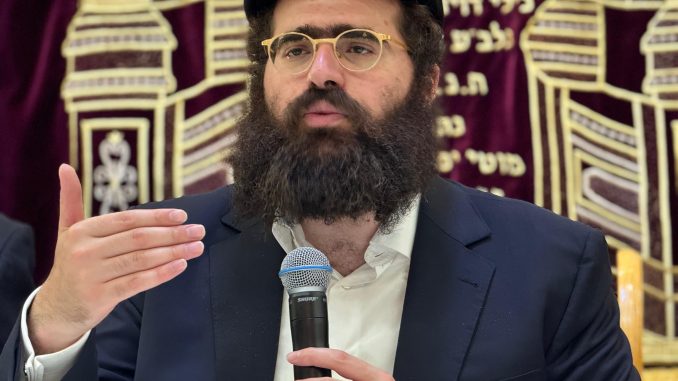
ASHDOD, Israel — In the bustling port city of Ashdod, as the salt air of the Mediterranean mingles with the frantic energy of pre-holiday preparations, Rabbi Moshe Yoel Pinto recently delivered a profound discourse on the true essence of the Hebrew month of Adar and the upcoming festival of Purim.
Speaking to a rapt audience, the Rabbi offered a spiritual roadmap for what he describes as a “great upgrade”—a month where the usual laws of destiny are suspended, and the Jewish people are invited to step into a realm of pure, unearned Divine grace.
The Architecture of Destiny
The Rabbi began by addressing the metaphysical concept of Mazal—a term often translated as “luck” or “destiny,” but which in Jewish thought refers to the fixed spiritual allotment assigned to an individual at birth. “God decrees who will be wealthy and who will be poor, who will succeed and who will struggle,” Rabbi Pinto explained. “That is the natural order. That is Mazal.”
However, the Rabbi posited that the unique power of Adar lies in the ability to transcend this blueprint. While the Jewish people are inherently “above Mazal,” the weight of daily life often pulls them back into the gears of natural cause and effect. Purim, he argued, is the moment when the natural order is bypassed entirely.
Quoting the Prophet Isaiah—“And it shall come to pass that before they call, I will answer; and while they are yet speaking, I will hear”—the Rabbi noted a startling nuance. Normally, God answers our necessities. But during Adar, God listens even to our “extra” requests—those things that are not strictly essential for survival, but which represent the deepest desires of the soul.
A Miracle Without a Name
A central mystery of the Purim story is the absolute absence of God’s name in the Megillat Esther. Rabbi Pinto explained that this was not an accident of history, but a reflection of the political reality of the time. Living under the thumb of King Ahasuerus, Mordechai and Esther could not explicitly document the Divine hand in their salvation.
“They had to write in hints and metaphors,” the Rabbi said. “Whenever the Megilla says ‘The King,’ the Sages teach us it refers not just to Ahasuerus, but to the King of Kings.”
This “hiddenness” is what gives Purim its unique standing in Jewish law. The Talmud asks: if a person must choose between studying Torah (the highest intellectual pursuit) or serving in the Holy Temple (the highest physical service) and reading the Megilla, which takes precedence?
The answer is the Megilla.
“Why?” the Rabbi asked. “Because Torah and the Temple represent the world of merit. We study and we sacrifice to earn our connection to God. But Purim represents a world beyond merit. In the story of Purim, the Jewish people didn’t perform great deeds to earn their salvation; they simply returned to the Truth.”
The Strategy of Silence
The Rabbi concluded with a poignant psychological insight into the character of Queen Esther. When she was taken to the palace, Mordechai commanded her to remain silent about her Jewish origins.
In a modern world obsessed with identity and self-expression, this silence seems counterintuitive. But Rabbi Pinto explained it through the lens of absolute conviction.
“When a person is 100% certain of something, they don’t feel the need to talk about it constantly,” the Rabbi observed. “We only argue, debate, and explain the things we are unsure of. By commanding Esther to be silent, Mordechai was telling her: ‘Your Jewishness is so foundational, so certain, that it requires no external validation.'”
This, the Rabbi argued, is the secret to surviving the “exile” of our own lives. It is not our ego or our loud declarations that save us, but our ability to “nullify” ourselves before the Divine. Like a small village protected by a vast empire, our safety lies not in our own meager defenses, but in our alliance with the Infinite.
As the residents of Ashdod returned to their homes to prepare for the holiday, the Rabbi’s message remained: Purim is not just a commemoration of a victory in ancient Persia. It is an annual invitation to step beyond the stars, to silence the ego, and to receive a grace that transcends the natural world.
Rabbi Moshe Yoel Pinto is a leading spiritual figure based in Israel, known for his deep insights into Chassidic thought and Jewish law and the first son and heir of Rabbi Yoshiahu Yosef Pinto, Shlita.
