
Live from Morocco
Introduction: A Legal Loophole with Spiritual Consequences
In the portion of Parashat Mishpatim, the Torah outlines the intricate laws of damages and liabilities. One of the most fascinating and seemingly counterintuitive laws is known as Be’alav Imo—the rule that if the owner of an object is working for the borrower at the time of the loan, the borrower is exempt from liability if the object is damaged.
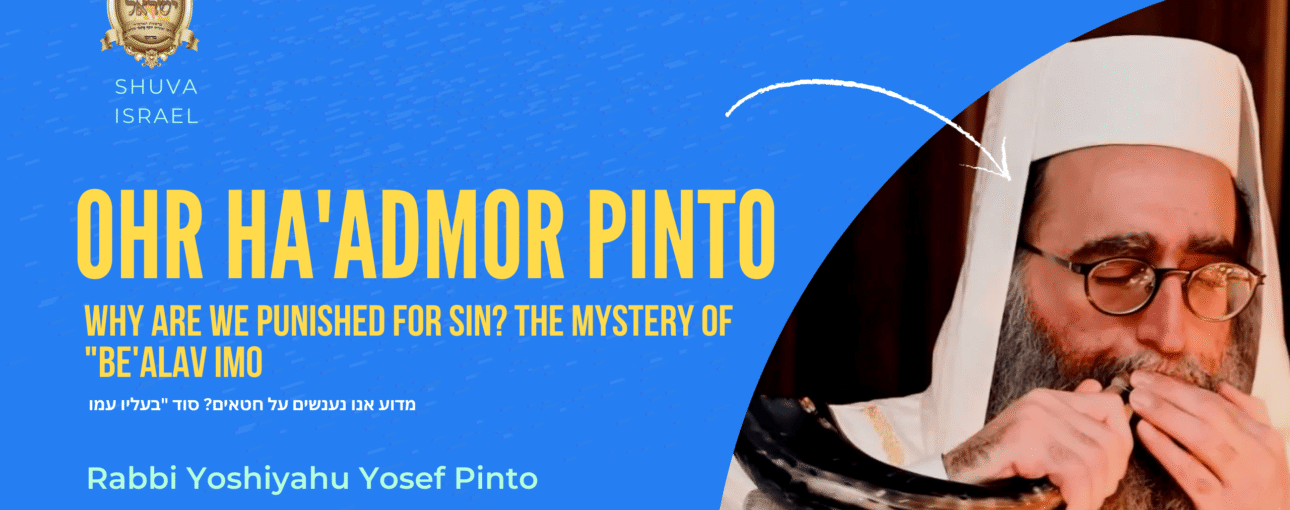
But is this just a civil law for the courtroom, or does it hold the key to our relationship with the Creator? In a profound shiur, Rabbi Yoshiyahu Pinto, Shlita, explores a daring question posed by the Ohr HaChayim HaKadosh: If God is the “Owner” of our souls and is always “with us,” why are we held accountable for our sins?
The Legal Framework: What is “Be’alav Imo”?
In Jewish law (Halacha), if you borrow a car from a friend and it breaks down, you are generally 100% liable. However, the Torah (Exodus 22:14) states: “If its owner is with him, he shall not pay.”
Rabbi Pinto illustrates this with a classic example:
Imagine you ask to borrow a friend’s car. Before he hands you the keys, you ask him, “Could you bring me a glass of water?” By bringing you that water, the owner is technically “in your service.” Because the owner was working for you at the moment the borrowing began, you are exempt from paying for any accidental damage to the car.
The Existential Question: The Soul as a Deposit
The Ohr HaChayim HaKadosh applies this legal logic to the spiritual realm.
-
The Soul is a Loan: Our soul (Neshamah) is a “deposit” from God. He is the Owner; we are the borrowers.
-
God is Always Serving Us: God provides us with life, breath, health, and sustenance every second. He is effectively “with us” and “serving” our needs constantly.
The Question: If the “Owner” (God) is always “with us” providing for our needs, shouldn’t we be exempt from “damages” (sins) done to the soul? Why does the Heavenly Court hold us liable for the spiritual damage we cause?
The Resolution: The Pre-Soul Oath
Rabbi Pinto explains the brilliant resolution offered by the Ohr HaChayim. In monetary law, any “condition” (T’nai) made before a transaction overrides the standard law.
Before a soul descends into this world, the Midrash tells us that God administers an oath: “Be a Tzaddik (righteous person) and do not be a Rasha (wicked person).”
This oath is a binding contract and a pre-condition. By accepting the soul under the condition of this oath, we waived our right to the Be’alav Imo exemption. We agreed to be 100% responsible for the soul, regardless of God’s constant providence and “service” to us.
Key Takeaways for Personal Growth
-
Absolute Accountability: We cannot blame our environment or our circumstances for our spiritual failings. We signed a contract before we were even born.
-
The Value of the Deposit: Our soul is the most expensive “object” ever borrowed. We must treat it with the care it deserves.
-
Gratitude vs. Responsibility: While we must be grateful that the “Owner” (God) is always with us, we must never use His kindness as an excuse for negligence.
Conclusion
The laws of Parashat Mishpatim are not just ancient civil codes; they are a blueprint for the soul. Rabbi Yoshiyahu Pinto reminds us that while God is a merciful “Owner” who provides for our every need, He has entrusted us with a mission. Our responsibility is to return the deposit—our soul—clean, pure, and intact.
