
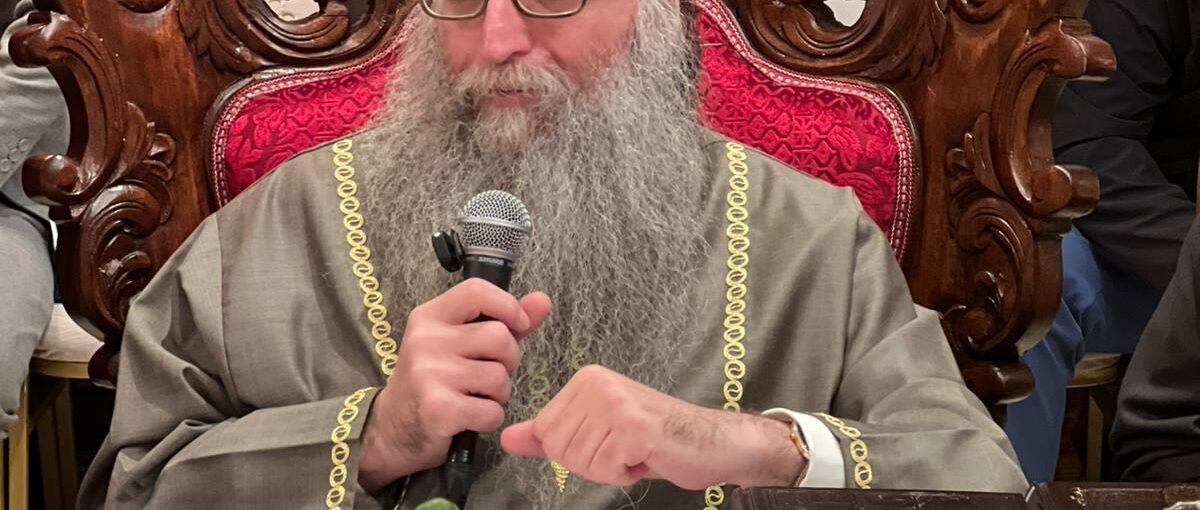
Words of Torah from His Eminence the Rebbe, Rabbi Yoshiyahu Pinto Shlit”a • Sunday Night, 15th of Shevat 5786.
“Now, therefore, if you will indeed obey My voice and keep My covenant, then you shall be My treasured possession among all peoples; for all the earth is Mine.” (Exodus 19:5)
Our holy Rebbe, the “Ohr HaChaim” of blessed memory, explains based on Bereishit Rabbah (21:6), that “Now” (Ve’ata) always refers to repentance. This is because the Israelites were sullied by the transgressions that preceded them, and also by the recent complaints when they were provoked, as written in the Torah regarding various sins concerning the manna, the quail, the Shabbat, and the water. When the Most High desired to give them the Torah – the foundation of holiness, purity, and spirituality – He commanded them to repent even from a minor sin. And indeed, we have already encountered the dictum of the Gemara (Kiddushin 49b) regarding one who betroths a woman on the condition that he is a completely righteous man, and he is found to be wicked, that his betrothal is valid. For we are concerned that perhaps he repented, and through his repentance, he is called righteous. Therefore, it is valid.
And behold, this day is a day mixed in our souls. On one hand, it is the Yahrzeit (hilula) of the great and holy luminary, who died sanctifying God’s name, Rabbi Yitzchak Abuchatzira of blessed memory, whose father, “Abir Yaakov” of blessed memory, testified that his soul was the soul of our holy Rebbe, the Ari. And it is a day of joy on the Yahrzeit of saints and righteous individuals, who are greater in their death than in their lives.
On the other hand, there is great and severe sorrow over the passing of the great and holy righteous woman, who was afflicted with suffering, and on the other hand, she accepted the sufferings with great love, and saw the sufferings as a gift from the Holy One, Blessed Be He. About a month ago, she earnestly sought to meet with us privately, and she spoke words that will remain with us for our entire lives. And one of the things she told us was that every pain and every suffering she went through was unbearable. She worked on herself to see and feel the sufferings as a gift she received from the Holy One, Blessed Be He.
A righteous and holy woman, who was one of the pillars of our holy community. And she returned her soul to the Creator of the world on holy Shabbat, and was blessed to merit a generation of upright individuals. Children who fear God, righteous and holy, who sacrifice themselves for the holy community. These words must bring us to a state of deep introspection, to delve into the essence of the life of each and every one of us.
“It is better to go to the house of mourning than to go to the house of feasting.” (Ecclesiastes 7:2) For there, one delves into a deeper understanding of life, and an understanding of what and why we came into this world. There are people who, in the rush of life, think or feel, or unknowingly, the rush of life leads them to live a life like “a horse rushing into battle,” and they think flawed thoughts that have no substance, and they do not understand the essence of life that man is born for toil, and the entire purpose of life is with a goal, for each to rectify his destiny for which he came into the world.
And behold, the rush of life, and the lack of knowledge of why we came into the world, or there are people whose very education from childhood did not teach them and they do not know what the purpose of life is, and they think that life was given to us to live and enjoy life, and to utilize it for momentary pleasures, and to let life pass by the person, without living life.
And by contemplating in the house of mourning the end of man, a spark may awaken that will lead the person to understand that life is a process of rectification, that the Holy One, Blessed Be He, brought man to this world to complete it. And happy is he who comes to heaven with his learning in his hand. And it is difficult, why did the Sages say “his learning” and not “his Torah” in his hand. For it is the learning he studied, what his purpose was in the world, and he completed his learning, like a person who goes to learn something and completes his study, and in the end comes with what he had to learn and complete, in all aspects and concepts.
Everyone has their learning, their destiny. This is in the study of Gemara, this is in the study of Halacha, this is in the study of Musar, and this is beyond the obligations that the Sages commanded us, the true Jewish foundation. We need beyond that, the learning, which is the study of what our purpose is in the world, to complete our rectification in the world, because everyone has their destiny and their rectification, and one must choose what their learning is, what their destiny is. And when the time of reckoning arrives and their time ends, they will ascend to heaven with their learning, the path they received on the day they were born into the world, to complete during their lifetime.
Therefore, we find that the great righteous individuals, among the Amoraim, requested from those who would eulogize them to write and tell them during their lifetimes what they would eulogize them for on the day of their passing. This is because the eulogy needs to announce, praise, and arouse the matters that were their portion in this world, and they wanted to hear and know that this is what they would be eulogized for on the day of their passing.
This is because it is known that our Sages told us that every person undergoes and will undergo three judgments. One judgment is every Rosh Hashanah, when all creatures pass before Him like marching sheep, and the Holy One, Blessed Be He, judges the whole earth, who shall live and so forth. This is one judgment, that every year on Rosh Hashanah, we are judged and sentenced.
The second judgment is on the day of burial, when a person is judged on what will happen to him and where he will be led, as we found with Rabbi Yochanan, who before his death cried, “I do not know which path they are leading me!”
And it is difficult: the greatest among the people of Israel fears which path they are leading him! Surely, he was one of the greatest among the people of Israel, so what is he afraid of? Rather, even a great and holy person, if he lived a life of holiness, purity, and service of God with righteousness and completeness, but did not walk in the path that was his destiny in life, and did not walk in the path for which he came into the world, he will not reach his proper place in heaven, and will need to return to the world again to rectify the world in the kingdom of God and to complete the rectification of the root of his soul.
And thus, righteous and holy individuals who did not rectify the root of their souls need to return through gilgul (reincarnation) to rectify the root of their souls. Therefore, he returned and cried before his disciples, that they should know to help their Rebbe after his death to sharpen his path, and to complete his path below in their lives so that he may stand with it in heaven, what he began in his life. And the merit of his disciples will stand with him in heaven.
Therefore, holy and righteous individuals warned with great caution to be precise in what they eulogize them for, not to exaggerate things that were not present, and to be accurate in what is said. And we have accepted upon ourselves for many years to avoid and be careful about what is said about the deceased on the day of the funeral, because if it is not precise and complete, or if it refers to things that were not their portion, it causes pain to the deceased.
And our holy Rebbe, the Ari, elaborated on these matters, and woe to a person who reaches the second day of judgment in his life, which is the day of burial, which is the second day of judgment after Rosh Hashanah, where he is judged on his deeds: did he fulfill the basic obligations of a Jew, the observance of Torah and Mitzvot? And on the other hand, it is the day of judgment: did he fulfill his mission in this world, the purpose for which he came into the world, the rectification for which he came into the world? And this is a difficult, second judgment for a person, and there it is determined whether his learning, which is his mission, was completed or, God forbid, not.
If so, it is determined how many deficiencies there were in his life, how many mistakes he made, and there the judgment begins, concerning the Mitzvot, the transgressions, the merits, the obligations, and how long he will be judged and where he will be and how his resurrection will be and how long it will be. And this is the depth of the sorrow, weeping, and prayer for the deceased.
And the severe mistake that has become ingrained in the world is that the world weeps for the absence of relatives, family members, friends who have passed away. And they think that the pain, sorrow, and weeping are for the absence of loved ones who are no longer with them. Father, mother, brothers, sisters, family members, friends. This is true; it hurts for the absence and for the love and connection that was severed. The absence of something that was part of you, of your life and livelihood. But the great and important mourning and weeping, because of which we mourn, is for the second judgment that the deceased undergoes on the day of the funeral. Where will he be, where is his place in the rectification for which he came into the world? Will he be judged and will his sentence be severe?
The body is a secondary matter, for the end of man is death, and this is the way of all the earth, and in the end, everyone returns their soul to the Creator of the world. The main weeping, the main sorrow, is the judgment of the father and mother, the family members, what will happen to the soul, where it will be decreed to go, what rectification and what sufferings it will undergo.
And over time, a culture is instilled in the world where the weeping and sorrow of the passing and funeral are for the absence and lack of departed relatives, and we must know and correct this error. Indeed, the sorrow is for the death, but the main weeping and sorrow are for the judgment of the deceased. But great and holy righteous individuals, like Abraham our Patriarch, “And Abraham came to mourn for Sarah,” with a small ‘kaph’ (כ) [indicating little], Abraham cried only a little for the absence of the body. But regarding Sarah’s destiny, Abraham our Patriarch knew that she had completed her learning, and completed her destiny and her rectification.
And immediately Abraham heard that Rebecca was born, who continued the destiny and rectification that Sarah was supposed to complete, and now Rebecca continues her new destiny, which is different in her actions and purpose from Sarah, and the world was completed in what Sarah came to complete.
And it is difficult: why is it a mitzvah to weep for a righteous person who passed away if he completed his rectification? If so, why the weeping and tears that one must shed for a righteous person?
Rather, because a person who has achieved great spiritual stature becomes a pillar of protection for his generation. And as long as he lives, he stops and blocks harsh decrees. Like Rabbi Zadok, as long as he lived, even though the destruction of the Temple was decreed, his greatness protected the Temple and protected the generation. And with the death of the righteous, the protection over the generation decreases, or many times the Holy One, Blessed Be He, takes perfect souls as atonement for the generation, and due to the sin of the generation, the righteous person passes away. And thus, everyone is culpable in the death of the righteous, who had to be taken from the generation as an atonement for the generation, and therefore the community as a whole bears guilt for the passing of the righteous.
And it is impossible not to grieve for a righteous person who was taken due to our sins. So, weeping and sorrow at a funeral are for the second judgment that a person experiences on the day of his passing, where he will be in heaven, Garden of Eden, God forbid, Gehenna, those who descend to Dumah (silence), etc.
And the third judgment will be in the future, at the end of days. The great and terrible Day of Judgment, where there will be the great and terrible judgment, who will rise for the resurrection of the dead and who will not rise, and their soul will be lost from the world.
These are the three great judgments that a person experiences every year. On Rosh Hashanah, on the day of the funeral, and on the great and terrible Day of Judgment in the future.
Therefore, on such a day as we stand, the Yahrzeit of a supreme saint, Rabbi Yitzchak, who stands and advocates for righteousness, and his power is great every single year, for the righteous are greater in their death than in their lives.
And a day of judgment for a great and holy righteous woman is a day of introspection and contemplation, both for prayer and weeping for the deceased, and also for our actions and where we stand.
Therefore, let the living take it to heart, where am I going? A person can fulfill Torah and mitzvot, but a person is not on the true path and goal for which he came into the world. And at this time, a person must remember the day of death. The meaning is to remember why I came into the world, what is the purpose, what is the destiny, am I walking on the right path, am I completing my mission and my true life’s goal, or am I like a horse rushing into battle, without purpose and without meaning for the root of my soul?
Therefore, when Rabbi Yehoshua ben Levi ascended to heaven and reached the partition of Rabbi Shimon bar Yochai, Rabbi Shimon bar Yochai asked him, “Did the rainbow appear in your days?” Why did he only ask this question, and no other?
Rather, because this was the destiny of Rabbi Yehoshua ben Levi, to rectify the general public. For the rainbow in the cloud symbolizes the low spiritual level of the generation, that they are not on the straight path, and Rabbi Yehoshua ben Levi’s destiny in the world was to straighten the path of the generation.
And these matters are extremely difficult in the difficult generation in which we live. People of faith have been lost, people with true faith and true knowledge of what our purpose is in the world have been lost. The world lives in a reality of day dragging day, matter dragging matter. We are in a generation of being dragged. In a generation that answers questions to ourselves and to those around us, and we lose the true understanding of our purpose in the world due to lack of knowledge, due to social pressure, due to lack of knowledge of what and why we came into the world, and this is a difficult war that we must fight in this generation.
“And you shall know the Lord” – to know God.
“And now, Israel, what does the Lord your God ask of you?” – to know what God demands of us.
And we must know that all Torah study and observance of mitzvot are obligations, and they are not something that we can do or want to do according to our desires and pleasures. Rather, it is our obligation, and beyond that, we have a rectification in the world for which we came, and it is not enough with study, prayer, and charity. Surely for this we will receive immense reward, but to be perfect and to do the will of our Creator, we must ask, seek, and examine every day by descending and delving into the depths of the soul, to know our destiny in the world.
Therefore, if someone has a sick person in their home, they should go to the wise person in their city. And we will explain these matters: a sick person is not necessarily someone who is lying at home or in a hospital. Rather, a sick person in their home is someone who sees and feels that there is illness in their home, in their marital harmony, in their livelihood, in their finding a spouse or in children who are not walking in the way of God, they should go to the wise person in their city. And why does the Gemara emphasize “in their city”? Because only a wise person who knows and understands the soul of the person and knows the person can point out where the deficiency and rectification are that need to be made in their soul.
Therefore, generations have been careful to say, “Make for yourself a rabbi.” And they were careful to greet their rabbi, so that their rabbi would know and understand and see the depths of their soul, and constantly check if they had not deviated from the path that is the root of their soul.
But repentance must also encompass the body and thoughts. The evil inclination still fights and exercises harsh control over the entire community, especially over thoughts.
People are careful with actions regarding meat and milk. The world is more careful in observing Shabbat, and also with matters of forbidden relations, and with faith, and with everything. Good deeds are performed, but the evil inclination has taken over and is taking over people’s thoughts.
People study Torah, but thoughts arise in a person’s mind that no generation ever conceived of thinking. People are careful with the attribute of Yesod (foundation/sexuality), but in thoughts, the evil inclination has broken and is breaking all conventions that were never conceived of, for generations. They are careful with faith in the Sages, but in thoughts, the evil inclination has broken all boundaries, leading their thoughts to severe matters. The evil inclination has lost ground through the laxity of the Jewish people in drawing closer to God, but unfortunately, it wins by breaking all the walls of thoughts.
And so, people repent, study in yeshivas, and even become rabbis who strengthen others. But in thought, they are unrestrained, and thus new thoughts break forth daily that are forbidden to even contemplate. And so, the world becomes closer to the Holy One, Blessed Be He, in deeds, but severely breached in thoughts.
And this is dangerous repentance, because it is repentance without roots. Repentance, “commandments learned by rote”. It is not true repentance until the Knower of Secrets testifies that one has truly repented. True repentance is complete, including thoughts. Repentance that is righteous in deeds but wanton in thoughts is dangerous repentance that leads a person to questions, to a lack of completeness in the service of God.
A person studies Gemara, Halacha, and even Kabbalah. But he straddles two fences, the fence of deeds and the fence of thoughts. And so, a person comes to question his rabbis, and from there to question the Holy One, Blessed Be He, and thus he loses his way.
Even though our Sages taught us that the Holy One, Blessed Be He, does not consider an evil thought, except for a thought of idolatry among the Jewish people. And the words of the holy Maharil (Rabbi Yisrael Salanter) of blessed memory in Shaarei Kedusha are well known, that the blemish of an evil thought causes the most severe damage.
Therefore, on the Yahrzeit of a supreme saint, a day of pain over the passing of a righteous woman, we must delve deeply and understand that we must repent in thought. “The end of an action is in the initial thought.” Don’t just look at the deed that you observed Shabbat, that you laid tefillin, that you gave charity. Rather, repent first in thought; with thought, a world of repentance in deeds will be created.
But the evil inclination has seized the world with difficult and evil thoughts. And this has become the nature and root of the world; from the evil inclination of the generation, everything is open, everything is under control. They see everything, talk about everything, think about everything. But through this, they “prune the saplings,” they prune sensitive and dangerous things, for there has been no generation in which all boundaries were broken like this generation.
And each and every one of us is commanded to stand at the city gate and arouse true repentance for the generation, to repent in thoughts. Thought has immense power. Even if one does not feel it, the moment one thinks, a long process begins, and so thought is built upon thought, and so on, until it reaches speech, and when a person meets another person with thoughts who has already fallen into the hands of the Samech Mem (Satan), they become a “company of friends” (referring to bad company).
And this can also be a person who appears to be a Torah scholar and righteous, but righteous in his deeds. A Torah scholar but with flawed and dangerous thoughts. God forbid, they do not eat meat and milk. They do not desecrate Shabbat in deeds. God forbid, they do not sin with forbidden relations. But a person desecrates Shabbat in thought, eats meat and milk, sins with all sins in thought.
And we must do complete repentance in the entire world of thoughts. To build a “guard for the guard” (a fence around the fence). To know that there are things that one does not think about, and does not bring to mind.
And behold, before the giving of the Torah, the most exalted time the world experienced since the creation of the world, the world awaited this day since the creation of the world. The Holy One, Blessed Be He, chose the people of Israel from all nations and gives the Israelites a complete rectification. A new building, a journey of hundreds of years from the Covenant Between the Pieces, two hundred and ten years of slavery in Egypt, ten plagues in Egypt, the splitting of the Red Sea. But before that sublime moment, the Holy One, Blessed Be He, asks of the Israelites, “And now.”
“Now” (Ve’ata) means nothing but repentance.
Repent with repentance, according to the words of our Rebbe, of blessed memory, concerning the past. What you corrupted in the land of Egypt, what you corrupted since the Exodus from Egypt, there is no possibility of receiving the Holy Torah without repentance.
“Now” (Ve’ata) means nothing but repentance. Repent with repentance to become a vessel to receive the Torah. And true repentance is complete, including thought.
Repentance in deeds, everything perfectly. Repentance in deeds without thought is the advice of the evil inclination. It is an opening for great corruption for yourself, for your family, and for all of Israel. Because repentance in deeds, without repentance in thought, over time, thoughts will become mixed with Torah, and a person who studies Torah and observes mitzvot will be built, but within his Torah will be the soul of evil thoughts. And at some stage in life, you will be the destruction of yourself, your family, your community, and all the people of Israel.
You will create disagreements, cooling down children who will not follow the path of God, and this will be “a year and he turned away.” You studied Torah but turned away. You turned away to evil thoughts, the hardest of all. You become the severe affliction on the path of God. And one of the things that straightens thoughts is when you know your purpose in the world and do not dispute the place [i.e., God’s decree].
Many people who do not know their purpose in the world dispute the place. They think, “This is not for me, this doesn’t suit me, this is not fair to me, I did it, they caused it to me, I tried.”
Everything comes from the depth of thoughts that a person has not repented for.
Therefore, we must go to the house of mourning, see the end of man, know how to do repentance in deeds and in thoughts, and know what my purpose is in the world. And there are times when your purpose is to fulfill a certain role in a certain way, and from there to do something else, and not to build a world of thoughts that ultimately lead you to actually lose your world, and you don’t even understand where you fell. For a person is close to himself, and always thinks that justice is with him.
And we already found concerning Elisha ben Avuya that he denied the root [of faith], and this came from a root of flawed thought that was at the beginning of his life. We must fight for complete repentance in deeds, but no less than deeds, repentance in thoughts, and to rectify repentance. And rectification in thoughts means being close to one’s true rabbis with correct views, with true thought. Not always the thought that seems convenient to you, not thoughts of comfort.
Regarding Absalom, son of David, who rebelled against his father, it is said that his father never caused him sorrow. David let him go with whatever thought he wished; he did not criticize him for his thoughts, to accept errors of thought with love, and not, God forbid, that a person should seek places that are comfortable for his thoughts and that give free rein to thoughts.
And behold, we grew up with our holy rabbis and fathers, who would delve into thoughts and criticize very severely for anything they thought had a hidden flaw. We remember our holy ancestor, Baba Meir, of blessed memory, who would criticize his relatives for a minor matter they would do at the Shabbat table. And when one of the great men of Israel asked why, Baba Meir answered him, “Every movement of a person signifies something deep in the soul. I criticize for something that seems minor, but its root is a root that will ultimately bear bitter fruit.”
Therefore, before the receiving of the Torah, and now, to return with complete repentance in deeds and in thoughts. And we must know that many of the thoughts and feelings are not ours; they are inherited from parents, from friends, from childhood, and from bad friends and bad things that have clung to and cling to a person over time.
“A perpetual fire shall be kept burning on the altar; it shall not go out.” (Leviticus 6:6) Keep the fire on the altar, which is a person’s knowledge, it shall not go out. Do not let thought wander aimlessly. “And you shall make a fence for your roof,” build a fence for your thoughts so that you do not fall from a high place.
“But He is merciful; He will forgive iniquity.” (Psalm 78:38)
“He will swallow up death forever, and the Lord God will wipe away tears from all faces.” (Isaiah 25:8)
With a broken heart.
