
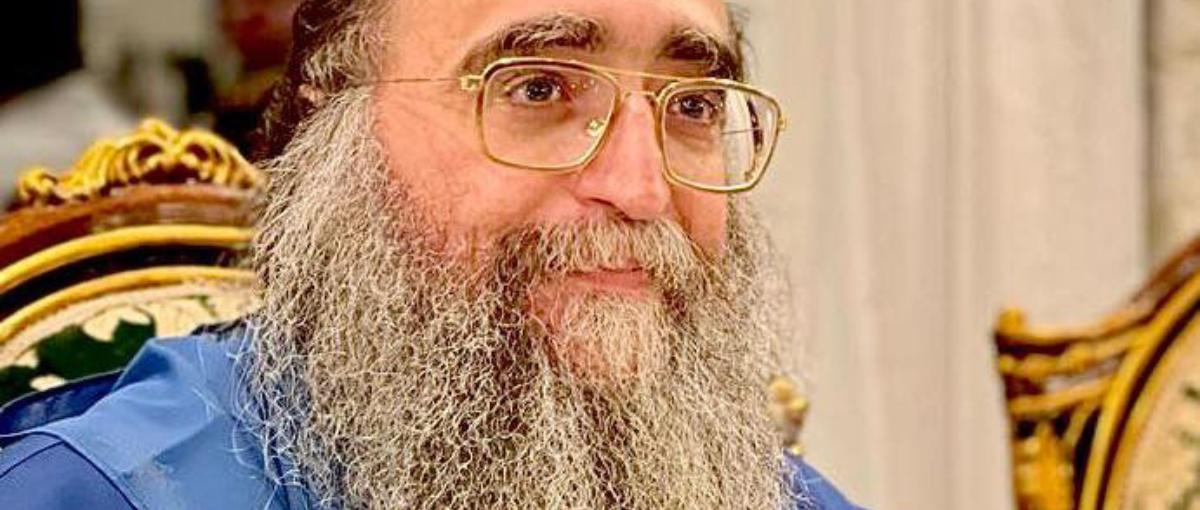
Torah Teachings from Ha’admor Rabbi Yoshiyahu Pinto shlit”a • Thursday, 4th of Shvat 5786.
Part 1:
“And Pharaoh rose up in the night” (Exodus 12:30)
Behold, we are on a holy day. We are in a holy day, the day of the Hillula [anniversary of passing] of my elder master/grandfather, our master Rabbi Yisrael Abuhatzeira [the “Baba Sali”], ztzuk”l [may the memory of the righteous and holy be blessed]. We must understand a great foundational concept in all true Jewish thought, regarding faith in the righteous (Tzadikim) who have passed away, and visiting the graves of Tzadikim.
We must understand what is the power, what are we actually doing when we visit the graves of the righteous, and what is so special and unique about the day of a Tzadik’s passing.
One must know the words of the Ran [Rabbi Nissim of Gerona]: Just as when a person sleeps, he neither hears nor sees, and an effort is required to awaken him from his sleep—because sleep contains a fraction of death—so too, when a person passes away, it is a very, very deep sleep, and the body wastes away in the dust, but something of the person remains in the grave. And at the Resurrection of the Dead, that “something” which remained will awaken, just as one awakens from sleep.
If the Ran says this, it is simple that even when a person passes away, something remains in his grave, from which the person will awaken and come to life at the Resurrection of the Dead. Therefore, when we go to the grave of a Tzadik, we awaken that “something” that remains in the grave. We connect to the holiness that remains in the grave, and we bind ourselves to the departed Tzadik.
Every year, each Tzadik ascends higher and higher through the Torah teachings he left in the world, and through the students and the deeds he left in the world, ascending from level to level. And the root of that spiritual level that ascends Above—that which remains of it in the grave also ascends along with the soul that ascends Above.
Therefore, “Tzadikim are greater in their death than in their life,” because in life, the Tzadik faces struggles and obstacles, and people with an evil eye who rebel against the Kingdom of Heaven. But when the Tzadik passes away and is freed from the S”M [the Accuser/Evil Inclination], he ascends higher and higher, and his power in the world and in his grave ascends and rises.
This is why our Sages said, “Whoever says words of Torah in the name of a Tzadik, his lips move [speak] in the grave.” Why specifically his lips, and not another part of his body? Rather, the mouth and the lips are the gateway to the soul, according to the words of the Holy Zohar. Therefore, the caution a person must take regarding his mouth and tongue is exceptionally great.
Thus it is brought in the book “Pituchei Chotam” by my elder master, the “Abir Yaakov” [Rabbi Yaakov Abuhatzeira] ztzuk”l, and these are his words:
“Behold, one who engages in Torah must guard his mouth from speaking evil things, and even idle chatter. For it is not fitting that a mouth used for holiness should be used for impurity.” The Holy Zohar warned about this matter (Vol. 2, 263). This is what King David, peace be upon him, said: “Who is the man who desires life, who loves days to see good?” (Psalms 34:13).
For behold, the Torah is called “life” and is called “good.” This is the meaning of “Who is the man who desires life”—this is the Torah. “Who loves days to see good”—this refers to one who rises at night to engage in Torah, which is called “good.”
Whoever desires to attain the Torah, it is: “Guard your tongue from evil and your lips from speaking deceit.” For if the mouth is full of deceit, that Torah becomes null and void, because it goes to the Sitra Achra [the forces of impurity].
And this is what is said in another verse (Psalms 50:16): “But to the wicked, Hashem said, ‘What right have you to recount My laws, and bear My covenant upon your lips?'” Why do you recount My laws with it [the mouth], since you have defiled that vessel, making it impure and unfit for sacrifice?
In the book “Aleph Binah” (Letter Mem, 8), our elder master the “Abir Yaakov” ztzuk”l explained these verses regarding prayer, which must also be uttered with a pure and clean mouth. And these are his words: “And the mouth that utters words of Torah, words of prayer, and blessings over Mitzvot, must be clean of words of lies and idle chatter. A despised and filthy mouth is not fit to serve before Hashem, nor to be a means to repair the upper worlds. As it is written (Isaiah 66:20), ‘Just as the children of Israel bring the meal-offering in a pure vessel to the House of Hashem.’ For a pure offering requires a pure vessel.”
And especially regarding prayer, which depends on the heart, through which the worlds ascend: If the mouth speaks lies, iniquity, and deceit, how can the worlds ascend through his mouth? Regarding this it is said, ‘He does not bless, rather he blasphemes.’
Therefore, whoever wishes for his prayer to be accepted must be exceedingly careful to guard his mouth and tongue exceptionally well; then his prayer will be accepted. Regarding this, King David, peace be upon him, said: “Who is the man who desires life, who loves days to see good? Guard your tongue from evil, and your lips from speaking deceit. Turn from evil and do good, seek peace and pursue it.”
The intention is: “Who is the man who desires life”—meaning, whose heart desires to draw down the supernal life through him, so that the upper worlds may be repaired/perfected. Thus far are his words.
Part 2:
Behold, the tongue of a person is his building and his destruction. The mouth can build a world through Torah and prayer, and likewise, it can destroy worlds. My elder master [the Abir Yaakov] ztzuk”l explains that a defect in the specific organ used to fulfill a Mitzvah is even more severe. As it is said: “You set your mouth to evil, and your tongue frames deceit” (Psalms 50:19). Therefore, if one speaks forbidden things with his mouth, his Torah is not desired; thus far are his words.
Behold, the tongue is the building and the destruction. Now, the tongue and the mouth are the “gateway of the soul” for both the living and the dead. For the living, the tongue and mouth either build or destroy the soul. For the dead, they also either raise or lower the soul. Thus, when one speaks evil of the deceased, there is a severe decree from one of the Rishonim (the Mordechai) not to speak [negatively] about a person who has passed, for in doing so, one rebels against and harms his soul. Conversely, when one speaks words of Torah [in their name], the lips and the tongue move in the grave, for from there comes the vitality of the soul.
We stand and connect ourselves to the Tzadik, for “Tzadikim are greater in their death than in their lives,” and we bind our souls with theirs. It is well known that anyone whose soul-root is connected to a specific Tzadik feels an illumination in his own soul on the day of that Tzadik’s passing. If one knows how to take that illumination and connection to the Tzadik in the correct and proper way—by studying his Torah and cleaving to the Tzadik’s deeds—he merits an “impregnation” (Ibbur) of the Tzadik’s soul within him.
On this holy day, the day of the Hillula of the Rabbi of all Israel in recent generations—the Rabbi of Israel in pure faith, true faith, simple faith (Emunah Peshutah). We take it upon ourselves to cleave to this simple faith and not a faith diluted by human intellect. Simple faith is required because the “intellectual” faith is the Yetzer Hara (Evil Inclination) of this generation. Everyone believes, but it is a “complex” faith: “How does it benefit me? Where is my personal good? How much will I get out of it? How much was I honored?” This is a defective faith, a faith that ultimately leads to sin, a faith that is “dependent on a thing.”
The Baba Sali was the Rabbi of Israel in total simplicity. Even though he possessed immense wisdom in every matter and great sophistication in worldly affairs, he knew how to distinguish between the sophistication of this world and his vast genius in worldly matters. When he reached the “matters of Hashem,” there was only absolute simplicity and absolute faith.
When the tongue is sanctified and does not lead a person to defect in faith, it fulfills the words of the Sages: “I believed because I spoke” (Psalms 116:10)—for through speech, faith is established in the place where the speech exists. One who speaks disparagingly or speaks Lashon Hara (evil speech), or is even a part of Lashon Hara, his faith is immediately damaged. The “Covenant of the Tongue,” the “Covenant of the Flesh,” and the “Holy Covenant” are all one. The soul, for good or for evil, begins its “nurturing” from the lips and the tongue. This is why we begin the Shemoneh Esrei prayer with: “Hashem, open my lips.” This is the gateway of the soul. We tie everything together with simple faith and by connecting to the Tzadik, who is greater in death than in life, and we ascend higher and higher with the soul of the Tzadik in the proper way. Not with empty joy, but with the joy of a Mitzvah, of Torah, and of learning from his deeds. Then, the power of the Tzadikim rests upon the person, and his reality becomes a different reality.
We see this tangibly: people who reached an immense level of cleaving (Dveikut) to Tzadikim and merited to ascend to lofty heights by connecting to the soul of the Tzadik found in his grave. Through his Torah and by cleaving to his deeds, they merited to see things that the eye and the intellect of this generation cannot comprehend.
One must know that every Tzadik has a specific power in which he is particularly great. One who binds his soul to a specific Tzadik and cleaves to him can see things in his own life that the Tzadik performed many years ago in a tangible way.
Behold, this day is a day to work on simplicity and pure faith. What a person who works on himself will merit, others who do not work on themselves will not understand—to what heights a person can reach who has unified and refined himself.
Based on this, we can understand the words of our master, the holy Ohr HaChaim, on the verse: “And Pharaoh rose up in the night.” These are his words: “The reason it says ‘night’ is explained according to the Holy Zohar—that that night was like a day that shines, like the clarity of day. I hinted at this in the verse: ‘And you shall tell your son on that day,’ for it intends to say that he should tell him also of the miracle of the night that became day… and so it says ‘And Pharaoh rose up in the night’—for Pharaoh it was night, but for the people of Israel, there was light and day.”
So it is with a person who does not believe: for him, it is darkness like Pharaoh. But there is a person in the exact same place for whom there is a great light. The power of faith and trust (Bitachon) in Hashem is an immense power, and it changes the entire essence of a person’s life.
For many years, we have endeavored to strengthen pure and simple faith. Our battle and our prayer to Hashem is: for anyone with pure faith, may Hashem strengthen and embolden him. And for anyone whose faith, Heaven forbid, is not simple and who has damaged his soul, we pray for Heavenly mercy upon him and from him.
For the destruction caused by a faith that is not simple—or is defective, or practiced “in order to receive a reward,” or based on pride—is dangerous. Even if it is not felt in this exact moment, one can see and feel the [negative] effects ten years later or more.
Let us fight for faith, let us cleave to the Tzadikim, and may we merit to continue the immense light of the holy community “Shuva Israel.” We pray, in the merit of my elder master Rabbi Yisrael Abuhatzeira ztzuk”l, for salvation for all the members of the community, and that we merit to cleave and unify our souls with the true faith and simplicity that my elder master possessed.
With great love,
The humble Yoshiyahu Yosef.
