
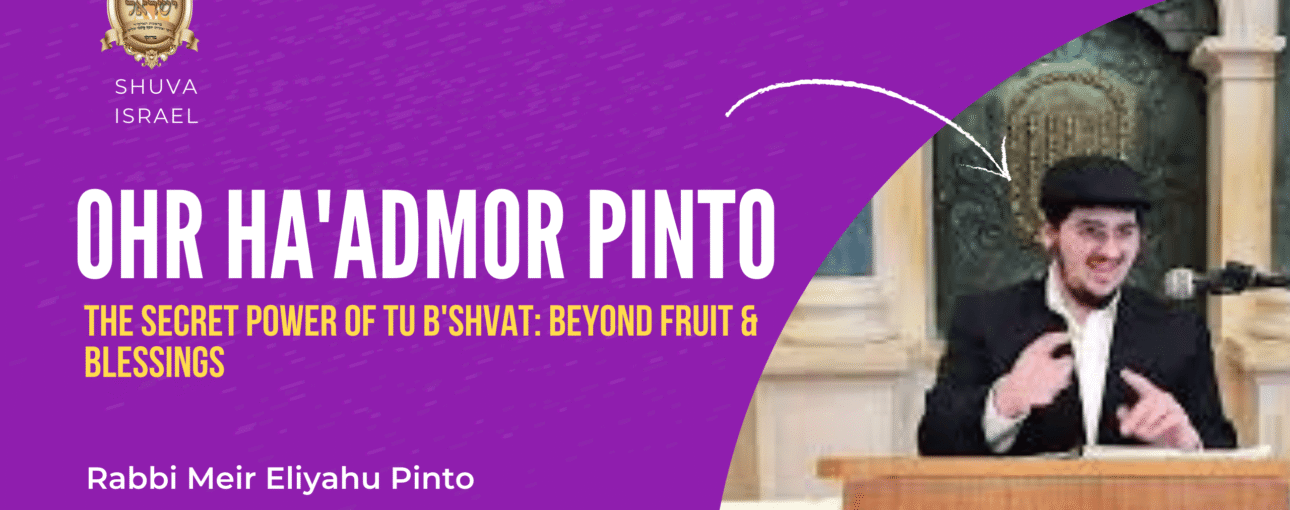
The Secret Power of Tu B’Shvat: Unveiling the Spiritual Depth of the “New Year for Trees”
Tu B’Shvat, often celebrated with plates of dried fruits and nuts, is much more than just a culinary holiday. In a recent captivating shiur, Rabbi Meir Pinto, Shlita, illuminated the profound spiritual significance of this special day, revealing its deep connections to great tzaddikim, the path of true righteousness, and the very essence of creation.
The Legacy of Rabbi Yitzchak: A Rav to the Baba Sali
Rabbi Pinto began by drawing our attention to the incredible legacy of Rabbi Yitzchak, the youngest son of Rabbi Akova. Rabbi Yitzchak, known for his immense kedusha and deep understanding of Torah secrets, was the esteemed teacher of none other than the Baba Sali, Rabbi Yisrael Abuchatzeira, zt”l. The Baba Sali himself, a renowned miracle worker and Dayan from Morocco, revered Rabbi Yitzchak as his rabbi, learning Gemara and Kabbalah at his feet.
Rabbi Yitzchak’s life was marked by extraordinary spiritual achievements, including his tragic martyrdom on Kiddush Hashem on a Friday, buried before sunset – a unique spiritual elevation. His lifelong pursuit of connection to Hakadosh Baruch Hu culminated in his passing, as he described, “Now when I pass away… now Hakadosh Baruch Hu wants to be connected with me.” This profound connection is a central theme, woven throughout the fabric of Tu B’Shvat.
Tu B’Shvat: Rosh Hashanah for Trees, a Time for Reflection
Why do we celebrate Tu B’Shvat? The Gemara identifies four Rosh Hashanahs, and the 15th of Shvat is specifically the “Rosh Hashanah for the Trees” (Rosh Hashanah La’Ilanot). This marks the time when the sap begins to rise in the trees, initiating the new cycle of fruit-bearing. It’s the point from which we count the three-year “orlah” period when fruit is forbidden, particularly in Eretz Yisrael.
Just as we pray for ourselves and our spiritual sustenance on Rosh Hashanah, Tu B’Shvat is a time to pray for the abundance and blessing of the fruits of the land. The minhag (custom) of eating fruits from Eretz Yisrael on this day, dating back over 400 years, isn’t merely about enjoyment; it’s an opportunity for deep contemplation and connection.
Beyond the Minimum: What Does it Mean to Be a “Chassid”?
Rabbi Pinto then posed a fundamental question: What does it mean to be a Chassid (a righteous, pious person)? The Gemara in Brachot states that “whoever wants to be a Chassid should be careful in matters of blessings.” At first glance, this seems straightforward – we are commanded to say blessings before eating! So what’s “chassidut” about it?
The answer lies in understanding the true intention and carefulness (Zehirut) behind our actions. Rabbi Pinchas, son of the Rama, offers a powerful mashal (parable): If you owe someone $100,000 and instead of repaying the debt, you bring them a beautiful basket of chocolates, does it help your debt? No! First, you must fulfill your basic obligation; then, your “extra” kindness is appreciated.
Similarly, before embarking on advanced spiritual practices (“chassiduyot”), one must first master the basics with Zehirut. This means being meticulous and thoughtful in every action, every word, every blessing. It’s not just about saying the words; it’s about connecting to their meaning. Rabbi Pinto powerfully stated that “a person who eats without a blessing is stealing from Hakadosh Baruch Hu,” because the land and its fruits belong to Him until we ask permission through a blessing.
This Zehirut is the first step towards true devotion, leading to Zrrizut (alacrity), Nekiyut (cleanliness of action), and ultimately, higher levels of serving Hashem. When we act with intention and caution, we avoid “foolish things” and progress steadily on our spiritual path.
The Spark of Elokut: Eating with Kedusha
Rabbi Pinto emphasized that our physical enjoyment of this world is not only permitted but encouraged when done with the right intention. Hakadosh Baruch Hu created a world teeming with diverse flavors, colors, and smells – 20,000 types of rice alone! This is a testament to His infinite greatness, and by appreciating it, we connect to Him.
Every single creation, from an inanimate rock to a growing plant, an animal, and especially a human being, contains a “spark of Elokut” – a holy animating spirit. The physical form is merely the klipa (shell), while the inner essence, the chayut, is the Divine spark that sustains its existence. A true tzaddik, like the Baal Shem Tov’s grandson, could see beyond the physical tree bark to the holy spirit within it.
When we eat fruit, we taste its sweetness, we smell its aroma – we are experiencing its chayut, its Divine spark. The peel (klipa) is discarded, and we absorb the good, the essence. This act, done with kedusha (holiness) and proper blessings, becomes a powerful form of tikkun (spiritual rectification).
Unlike the traditional methods of tikkun through fasting and self-affliction (which are less applicable in our times), Tu B’Shvat offers a unique path: through eating. By consciously enjoying the fruits of Eretz Yisrael, recognizing the Divine spark within, and saying our blessings with Zehirut, we elevate the physical act into a spiritual one, connecting ourselves more deeply to the Creator.
Conclusion
Tu B’Shvat is a profound reminder that holiness can be found not just in prayer and study, but also in the conscious, intentional enjoyment of the physical world. By embracing Zehirut in our blessings and appreciating the “spark of Elokut” in every bite, we transform a simple meal into a powerful act of spiritual elevation, connecting us to the vastness of creation and the infinite greatness of Hakadosh Baruch Hu. Let us use this Tu B’Shvat to truly taste the sweetness of the world, and in doing so, taste the sweetness of G-dliness itself.
