
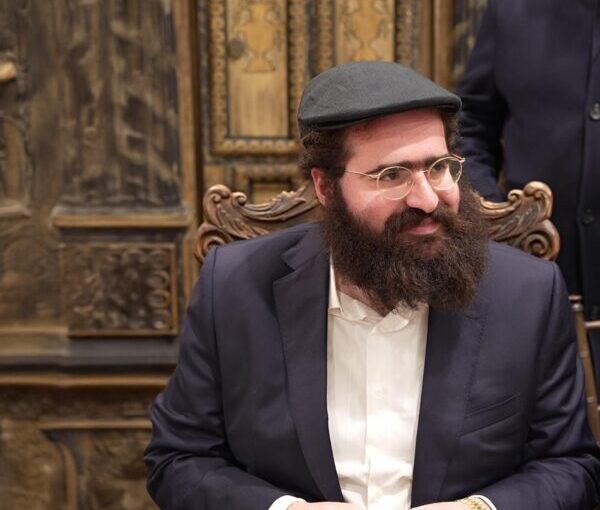
Ashdod, Israel – 19th February, 2026
By Shuva Israel Editorial Team
In a profound and challenging discourse recently delivered to his students, Rabbi Moshe Yoel Pinto Shlita offered a startling look into the mechanics of the human soul and the nature of Divine judgment. Drawing on the esoteric teachings of the Baal Shem Tov, the Rabbi presented a paradox that flips conventional religious confidence on its head: In the eyes of Heaven, we are often the exact opposite of who we think we are.
The Great Inversion
Rabbi Pinto began with a radical premise. Most people spend their lives attempting to cultivate a sense of righteousness. We strive to feel like a Tzaddik—a righteous person. Yet, the Rabbi warned that this very feeling might be the clearest indicator of spiritual distance.
“Know this,” Rabbi Pinto stated with characteristic intensity. “Whatever you think of yourself, the Holy One, Blessed be He, thinks of you exactly the opposite.”
According to the Rabbi, the person who walks through the world convinced of their own piety, expecting the world to acknowledge their holiness and asceticism, is often viewed by the Divine as a Rasha (a wicked person). Conversely, the individual who is haunted by their own inadequacies, who feels like a “Rasha” or unworthy of God’s gaze, is often the very one whom God holds close as a true Tzaddik.
Thought as a Battlefield
The Rabbi delved into the nature of “thought” (Machshava), noting that while both humans and God possess the capacity for thought, they exist on entirely different planes. He cited the verse from Isaiah: “For My thoughts are not your thoughts, neither are your ways My ways.”
While we often interpret this to mean God is simply smarter than us, Rabbi Pinto suggests a more psychological nuance. Our thoughts are often clouded by ego, imagination, and self-interest. We see reality through the lens of our own desires. God, however, sees the root of the soul. When we are most satisfied with our “spiritual achievements,” we are often at our most ego-centric.
The Five Pitfalls of the Modern Leader
The centerpiece of the shiur was a scathing but vital critique of spiritual ambition, based on a teaching from the Toldot Yaakov Yosef (the primary disciple of the Baal Shem Tov). The Baal Shem Tov predicted that in the generations leading up to the Messiah, religious leaders would succumb to a specific five-stage evolution of ego, mirrored in the names of the first five tribes of Israel.
-
Reuven (Re’u-ni: “See me”): The first stage is the hunger for recognition. Like the name Reuven, which implies “See, a son,” the seeker wants to be noticed. They want the world to see them as a “son of God,” a person of stature and fame.
-
Shimon (Shama: “Hear”): The ego grows. Now, it is not enough to be seen; one must be heard. This represents the pursuit of reputation—wanting one’s name to be on everyone’s lips, seeking the “noise” of public acclaim.
-
Levi (Levayah: “Escort”): Here, the ambition turns toward power and influence. The name Levi suggests an accompaniment or a convoy. The seeker now desires a “retinue”—a mass of followers and a large camp to surround them.
-
Yehudah (Hoda’ah: “Thanks/Acknowledge”): This is the stage of vanity. The seeker craves constant gratitude and acknowledgment. They want the world to thank them, to praise them, and to validate their greatness.
-
Issachar & Zevulun (The Transaction): Finally, the spiritual path is fully commodified. The goal becomes “Issachar and Zevulun”—the biblical archetype of the partnership between Torah study and commerce. At this stage, the religious persona is used simply for financial gain and personal profit.
The Path of True Humility
Rabbi Pinto’s message was a clarion call for internal honesty. He suggested that the rabbis and seekers of the final generation must be wary of these five “tribes” of the ego.
True spirituality, he argued, is found in the quiet struggle of the person who feels they have no power, no ability, and perhaps no merit. It is in that brokenness—that lack of self-importance—that God finds a dwelling place.
“The way to God,” the Rabbi concluded, “is through the realization that we are far from Him. When you think you are nothing, that is when you are truly something in His eyes.”
As we navigate an era of “personal branding” and public piety, Rabbi Pinto’s words serve as a necessary corrective: The mirror of the soul does not reflect how we look to the world, but how we look when the lights of the world are turned off.
