
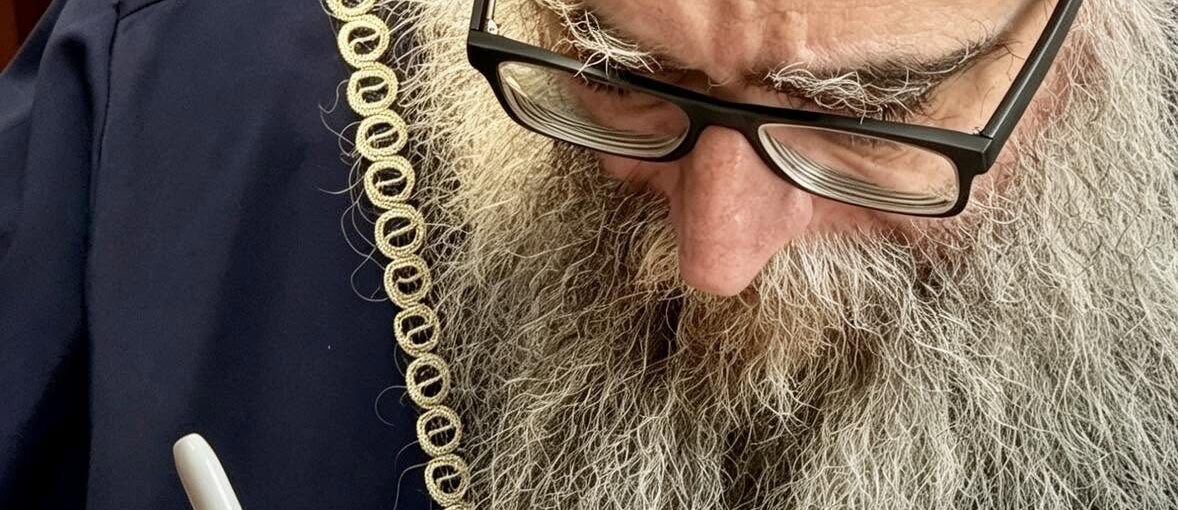
The Well That Never Ran Dry: Uncovering the Hidden Accuser Behind Human Desire
A Torah Insight from Rabbi Yoshiyahu Yosef Pinto, Shlita
There is a question worth sitting with: how many times have you suddenly wanted something — and a day, a week, or a year later, couldn’t remember why it mattered so much? How many purchases, arguments, or anxious nights were spent chasing something that, in retrospect, you never actually needed?
This week’s shiur on Parashat Chukat, delivered by Rabbi Yoshiyahu Yosef Pinto, opens a window into exactly this experience — and reveals that it has a name, a source, and a remedy that goes back to the very first days the Jewish people walked in the desert.
A Test Forty Years in the Making
The shiur begins with a teaching shared at the Friday night Shabbat table, built on the Or HaChaim’s treatment of one of the most painful episodes in the Torah: Moses striking the rock at Mei Meriva, the act that cost him entry into the Land of Israel.
Rabbi Pinto poses the question that troubles every reader of this story. Why would God seemingly place Moses in an impossible position — commanding him to speak to the rock, yet allowing circumstances that led him to strike it instead? This is not how God operates, Rabbi Pinto explains. There had to be a reason.
The answer, he suggests, reaches back forty-one years, to the very beginning of Moses’s mission at the burning bush. There, God first told Moses to go and speak to the Children of Israel, to tell them through words alone that redemption was coming. Moses refused. He doubted that speech would be enough — he insisted the people needed signs, wonders, a staff that could turn into a snake. God acquiesced and gave him the miracles he asked for.
Now, four decades later, at the very end of his leadership, Moses faced the same test in mirror image: would he trust that speech alone — without the staff — could bring forth water from a rock? Rabbi Pinto frames this not as a new failure but as an unfinished correction returning to complete itself. The sin of distrust in speech, planted at the beginning of his mission, needed one more encounter before Moses’s earthly task could be considered whole.
It’s a striking reminder that the tests we fail are rarely random. They tend to circle back, sometimes years later, asking to be met differently the second time.
Guarding the Mouth and the Tongue
From here, Rabbi Pinto turns to a teaching of Rabbi Yaakov Abuchatzeira on the verse describing one who “guards his mouth and his tongue.” Why, he asks, does the verse need both words? The mouth speaks; the tongue is what speaks with. Aren’t they the same thing?
Rabbi Yaakov’s answer reframes the verse entirely. The “mouth,” he explains, refers to the holy covenant — the deepest expression of a person’s self-discipline — while the “tongue” refers literally to speech, particularly the avoidance of gossip. The two are bound together: a person’s command over his own body and a person’s command over his own words are, at their root, a single discipline. Guard one, and you are protecting the other.
The Judgments Only Torah Can Sweeten
One of the most striking teachings of the entire shiur concerns a category of spiritual difficulty that many people never realize exists.
Rabbi Pinto, citing Rabbi Yaakov Abuchatzeira, explains that there are specific harsh judgments — particular forms of difficulty a person can carry — that simply cannot be dissolved through charity, kindness, or even prayer alone. They can be eased. They can be quieted for a time. But they return.
He offers a vivid image to make the point land: a person in pain takes a painkiller. The pain subsides — but the underlying infection, the pus, remains exactly where it was. Only the right medicine treats the actual source. In the same way, certain spiritual judgments require the specific remedy of sustained Torah study. No substitute will do.
This is a teaching many people resist, Rabbi Pinto notes, because it’s natural to think: I give charity, I do good deeds, surely that covers everything. But some forms of difficulty, he insists, are simply not designed to respond to anything except direct engagement with Torah. The good deeds still matter — but they are not interchangeable with this one.
Why Purity and Torah Are Inseparable
The shiur then turns to a puzzling phrase from the Torah portion itself. The verse introducing the laws of the red heifer — a ritual concerning purification from contact with death — is introduced with the words “this is the statute of the Torah,” rather than simply “the statute of purity.” Why connect the entire Torah to a single ritual law?
Drawing on the Or HaChaim, Rabbi Pinto explains that the capacity to become spiritually impure through contact with death is not a universal human condition — it is unique to the Jewish soul, a soul that received an additional dimension at Mount Sinai through receiving the Torah. A non-Jew, the law states, does not contract this impurity even through direct contact with a body. The very possibility of this impurity, then, flows directly from the gift of Torah itself. Where there is no Torah-soul, there is no such impurity; where there is, purity becomes essential to protect.
Rabbi Pinto illustrates this with an image: place a jar of honey and a jar of garbage outside, and the flies will gather around the honey, not the garbage. The Jewish soul, infused with the “honey” of Torah, becomes a place that spiritual forces are drawn toward — for good or for harm — which is precisely why guarding its purity matters so deeply.
The Heart of the Lesson: Manufactured Desire
Now we arrive at the teaching that gives this episode its name.
Just three days after the splitting of the Red Sea — after witnessing what Rabbi Pinto describes as revelations beyond what even the great prophets later saw in their visions — the Children of Israel ran into a stretch of desert without water. They arrived at a place called Marah, where the water was bitter and undrinkable, and the people complained bitterly to Moses.
Rabbi Pinto, following Rabbeinu Bachaye, asks the obvious question: how does a generation that watched the sea split in two, that saw ten plagues, that walked on dry land through walls of water — how does that same generation collapse into complaints over a temporary lack of water, just three days later?
The answer Rabbeinu Bachaye offers reframes the entire incident. There exists, in this telling, a specific spiritual force — described as “the minister of the desert” — whose role is to accuse and destabilize. This force did not create a genuine crisis. The people, Rabbi Pinto points out, likely still had water remaining in their containers. The complaint was manufactured: an external accusation took root and produced, almost out of nowhere, a desire and a distress that hadn’t truly existed moments before.
This is where Rabbi Pinto makes the teaching universal. He estimates that a significant majority of what people believe they need — possessions, comforts, even relationships — are not authentic needs at all. They are responses to an unseen accusation, a spiritual disturbance that manufactures craving where none belonged. A person suddenly wants something. He becomes fixated. He may even compromise his values to obtain it. And often, Rabbi Pinto teaches, the root of that sudden hunger is not lack — it’s accusation.
The practical takeaway is sobering: the next time a craving or grievance arises with surprising intensity, it may be worth asking not “how do I satisfy this?” but “where did this actually come from?”
The Tree of Life Beside the Bitter Water
The story deepens further. According to Rabbeinu Bachaye, the tree that God showed Moses at Marah — the one thrown into the water to sweeten it — was none other than the Tree of Life, the same tree that stood in the Garden of Eden. It had been present near the water all along.
So why the complaints in the first place, if the remedy was right there? Rabbi Pinto explains that the very same accusing force had removed the Tree of Life from its place, specifically to prevent the people from accessing it — fearful, in a sense, of what its presence would mean for them. Only once Moses cried out in prayer did God restore the tree to its place, sweetening the water and resolving what the accusation had stirred up.
The lesson lingers: sometimes the remedy to our distress has been near us the entire time. What blocks us isn’t its absence, but an active force working to keep us from recognizing it.
Miriam’s Well: Water From Before Creation
The episode closes with one of its richest threads — the story of Miriam’s Well, a well so significant that Jewish tradition counts it among ten extraordinary things created in the twilight hours just before the very first Shabbat.
Drawing on the Ramban and Rabbeinu Bachaye, Rabbi Pinto traces this well’s mystical history. It was, according to this tradition, no ordinary water source. It had provided water at pivotal moments throughout biblical history — including, notably, for Ishmael in the wilderness — and it accompanied the Israelites throughout their decades in the desert. Its provision was bound to the merit of Miriam herself, whose very name carries within it the Hebrew word for water. When Miriam passed away, the well’s flow ceased; it returned only once Moses, in his own merit, drew from it again.
Rabbi Pinto notes the layered symbolism: this was not new water suddenly appearing, but “its waters” — meaning waters that had already flowed before, now simply resuming their accustomed course. The well, like certain forms of spiritual provision, isn’t created fresh each time it’s needed. It is drawn, when the moment calls for it, from a source that has existed since the beginning.
Why Moses Could Not Enter the Land
The shiur also surveys the range of explanations the tradition offers for why Moses was ultimately barred from entering the Land of Israel — striking the rock rather than speaking to it, the gap in time between his two strikes, the people’s failure to sing a song of gratitude over the water that emerged. Rabbi Pinto presents these not as competing theories but as different facets of a single, multidimensional truth: that even the greatest of leaders is held to an extraordinarily precise standard, and that the consequences of even small departures from instruction can carry enormous weight.
From Cistern to Spring: Growing in Torah
The episode closes with a teaching from the Malbim that offers a hopeful framework for anyone who feels they are only beginning their relationship with Torah study.
There are three stages, the Malbim explains, corresponding to three types of water-gathering described in the verses. A person beginning their study is like a cistern — simply collecting whatever they encounter, piece by piece, from wherever they can find it. With time and effort, a person becomes like a well — someone who can draw up wisdom from a source within themselves, not merely gathering but generating. And ultimately, a person can become like a spring — a source from which Torah insight flows outward freely, nourishing others as well.
No one begins as a spring, Rabbi Pinto reminds us. Every flowing source began as a cistern, gathering one drop at a time.
A Closing Reflection
What makes this week’s teaching so striking is how directly it speaks to ordinary life. Most of us will never stand at the foot of a desert well or witness a sea split in two. But nearly all of us have felt a craving arrive uninvited, demand our attention, and then quietly fade — leaving us to wonder what it was even about.
Rabbi Pinto’s teaching offers a different lens for those moments: not every desire deserves to be chased, and not every complaint reflects genuine lack. Sometimes the wisest response to a sudden craving is not to satisfy it, but to pause and ask where it actually came from — and to remember that the deepest waters, the ones that truly sustain us, were often there all along.
This blog post is based on the Torah teachings of Rabbi Yoshiyahu Yosef Pinto, Shlita, as delivered in Episode 18 of the Shuva Israel Podcast. The podcast is a direct English translation of Rabbi Pinto’s Hebrew shiurim.
🎧 🎧 Listen now:
Apple Podcast: https://shorturl.at/lWxGu
Spotify: https://shorturl.at/cGRj3
📱 @Shuva Israel – Morocco
📱 Follow Shuva Israel on Instagram, Facebook, and YouTube
