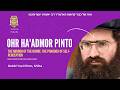
LOS ANGELES — In a world increasingly defined by the frantic pursuit of the “instant”—instant wealth, instant fame, and even instant spiritual enlightenment—Rabbi Yoshiyahu Pinto offered a sobering counter-narrative during a recent live shiur in Los Angeles. Speaking to an intimate gathering at the home of his hosts, Yossi and Vered, the Rabbi wove together ancient Talmudic debates and sharp psychological insights to deliver a roadmap for navigating the “nighttime” of the human experience.
The Cosmic Tension: Tishrei vs. Nissan
At the heart of Rabbi Pinto’s discourse was the classic dispute between Rabbi Elazar and Rabbi Yehoshua regarding the creation of the world. Does the calendar truly begin in Tishrei, the season of judgment and nature, or in Nissan, the month of miracles and the Exodus?
For Rabbi Pinto, this is not merely a chronological curiosity but a fundamental guide for human conduct. Tishrei represents Din (judgment) and the natural order—the grueling, systematic effort of waking up, working, and maintaining discipline. Nissan represents the supernatural—the parting of the sea and the shattering of chains.
“A person must live their life first by the laws of Tishrei,” Rabbi Pinto explained. “You cannot simply wait for a miracle to fall from heaven. You must rise in the morning, do what is required by nature, and build a vessel of order. Only then, in the ‘Month of Nissan,’ does God provide the miracle to fill that vessel.”
The danger, he warned, lies in the “shortcut.” He cited the tragic figure of Elisha ben Abuya—the great sage who became a heretic. Elisha’s mistake was a refusal to climb the ladder of nature. He sought the “fire” of the spiritual heights without the “wood” of earthly discipline, a pursuit that led to his ultimate spiritual collapse.
The Anatomy of Deceit
To illustrate the consequences of spiritual hubris, Rabbi Pinto turned to a chilling Midrashic account of Ahab ben Kolaiah and Zedekiah ben Maaseiah, false prophets in Babylonian exile. These men used their “imagination”—a gift intended for holiness—to architect elaborate deceptions, even attempting to seduce the wife of Nebuchadnezzar under the guise of divine command.
Their end in a Babylonian furnace, contrasted with the survival of the righteous Joshua ben Yehozadak, served as a stark warning against the corruption of the mind. “The generation we live in wants everything fast,” the Rabbi noted. “But when you try to cook at the highest heat to save time, you don’t get a meal; you get a fire. There are things in life that must be baked slowly.”
Burning the Internal ‘Chametz’
As the Jewish world prepares for Passover, Rabbi Pinto redefined the traditional search for chametz (leavened bread). In the metaphysical sense, chametz is the ego—the soul “puffing up” beyond its true dimensions.
“Egypt was the capital of imagination,” he said, describing a society that took the blessings of the Nile and converted them into sorcery and immorality. The Exodus, therefore, is the process of stripping away the “swollen” false self. Passover is not merely about cleaning a kitchen; it is about “burning the internal chametz“—the negative traits and arrogance that cloud a person’s judgment.
The Weight of a Word
Perhaps the most resonant portion of the shiur for the modern audience dealt with the ethics of speech. Rabbi Pinto spoke with uncharacteristic intensity about Bal Tomar—the prohibition against repeating something told in confidence.
“When someone tells you a secret, a piece of their soul is now residing with you,” he explained. “When you repeat it, you are mishandling that person’s spirit.”
He linked the act of gossip (Lashon Hara) to a person’s literal destiny. According to the Rabbi, every person has a “file” in the heavenly court that remains closed as long as they remain silent about others. “The moment you open your mouth to speak ill of your neighbor, you trigger the opening of your own file. You invite the universe to scrutinize your own shortcomings.”
Faith in the ‘Nighttime’
Closing with the teachings of Rabbi Elazar ben Azaryah, who famously claimed he was “like a man of seventy years,” Rabbi Pinto addressed the modern plague of anxiety. He noted that even great sages struggled to understand how the Exodus—a moment of light—could be remembered “at night” (in times of darkness and suffering).
His message was one of empowerment through the “Exodus of the mind.” Whether facing financial hardship, spiritual blockage, or the “night” of clinical anxiety, the Rabbi urged his followers to lean into the “Nissan” energy of the current month.
“In Nissan we were redeemed, and in Nissan we are destined to be redeemed,” he concluded. “Every person has their own ‘Egypt,’ their own narrow place. The power of this month is the power to step out of the natural order and find the miracle waiting in the dark.”
Rabbi Yoshiyahu Pinto is the leader of the Shuva Israel organization, providing spiritual guidance and charitable support to communities worldwide.