
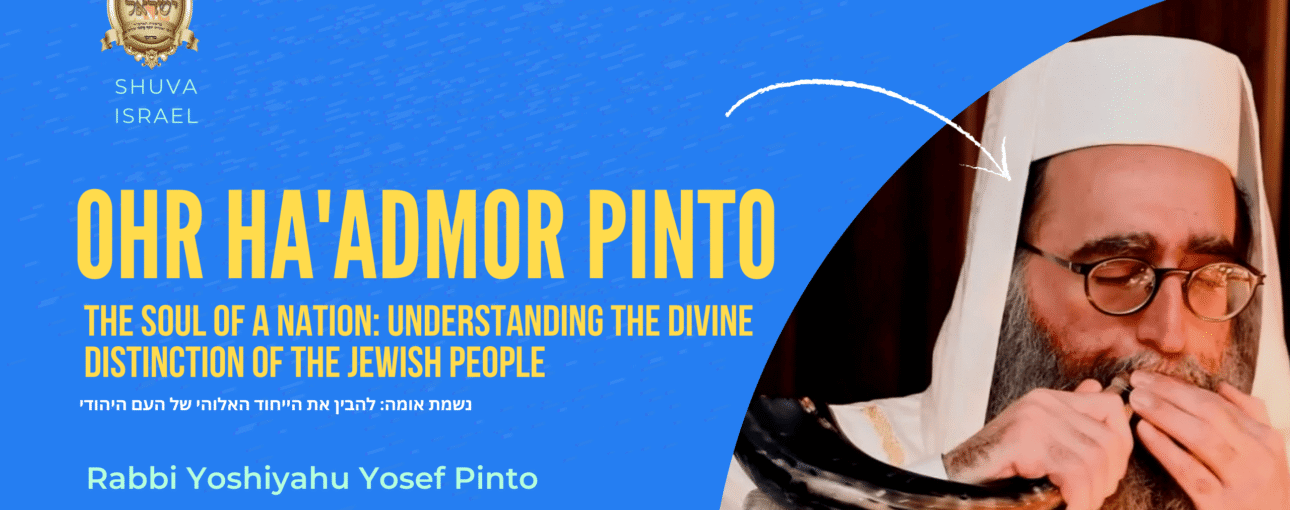
In a world that increasingly values universalism and shared logic, the Holy Torah in Parashat Bo presents a striking and counter-cultural truth. In a recent, deep-dive shiur, Ha’admor Rabbi Yoshiahu Yosef Pinto Shlita explores a foundational principle: the perception, logic, and soul of a Jew are fundamentally different from the rest of the world.
To live as a Jew is not merely to follow a set of laws; it is to see the world through a “Jewish lens” that has been polished over thousands of years.
Jewish Logic vs. Intellectual Wisdom
Rabbi Pinto begins by clarifying a common misconception. While the nations of the world possess “wisdom” (intellectual genius and rational thinking), the Jew possesses something entirely different: a “Soul-Intellect.”
A genius can make a rational decision based on the current moment, but a Jew makes decisions rooted in a “chain upon chain” connection to previous generations. This is not just a brain at work; it is the Jewish soul expressing itself. When we study Torah only as an intellectual pursuit, we miss its essence. To truly learn is to engage with the Torah’s spiritual and mental depth, reviving the tradition from master to disciple.
The Crucible of Egypt: A Divine Separation
Why did we have to suffer in Egypt for 210 years? Rabbi Pinto explains, citing the Holy Zohar, that Egypt was the “womb” of the Jewish people. We were born out of the darkness of that exile.
The Ten Plagues (Ten Makot) were not just punishments for Pharaoh; they were a process of Havdalah (separation). Through blood, frogs, and darkness, Hashem was surgically detaching the Jewish soul from the Egyptian identity. This separation ensured that while we lived among the nations, we would never become of the nations. This is why we mention the Exodus in every prayer—it is the moment we became “Adam” (Man) in its highest sense.
The Secret of the Embryo: The Mission of Exile
The Rabbi touches upon a mysterious concept: “The secret of the embryo is not revealed to the nations.”
He explains that the Jewish people are sent into exile among the 70 nations for a specific purpose—to collect “Holy Sparks.” Like an embryo in the womb that draws nutrients from its mother to grow, the Jewish people draw out the spiritual sparks hidden within the nations.
Historically, wherever Jews settled, those countries thrived. When the Jews left, those countries often lost their luster. This is because the “sparks” were gone. Our mission in exile is to gather these elevations and bring them back to their source in holiness.
True Kindness and True Morality
Finally, the Rabbi distinguishes between secular morality and Jewish morality.
-
Secular Kindness: Often based on social contracts or intellectual reasoning (“I give so that I may receive”).
-
Jewish Kindness: A deep, soul-level compassion that stems from our connection to the Creator.
A Jew who tries to think and act like a Gentile might succeed in being a “good person,” but they are disconnected from their true power. To be a “Moral Jew” is to act from the depth of a soul that was present at Sinai.
Conclusion: Returning to Our Roots
The lesson of Parashat Bo is a call to every Jew to recognize their uniqueness. We are not a “rational machine”; we are a link in an eternal chain. By viewing our lives through the vision of the Torah and Kabbalah, we tap into a power that transcends worldly logic.
Watch the Full Shiur:
To understand the full depth of these secrets and hear the words of Ha’admor Rabbi Yoshiahu Yosef Pinto Shlita, watch the complete video on YouTube:
