
In the depths of the Jewish soul, there is a recurring question that has echoed through the generations: How do we hold onto faith when the night seems endless?
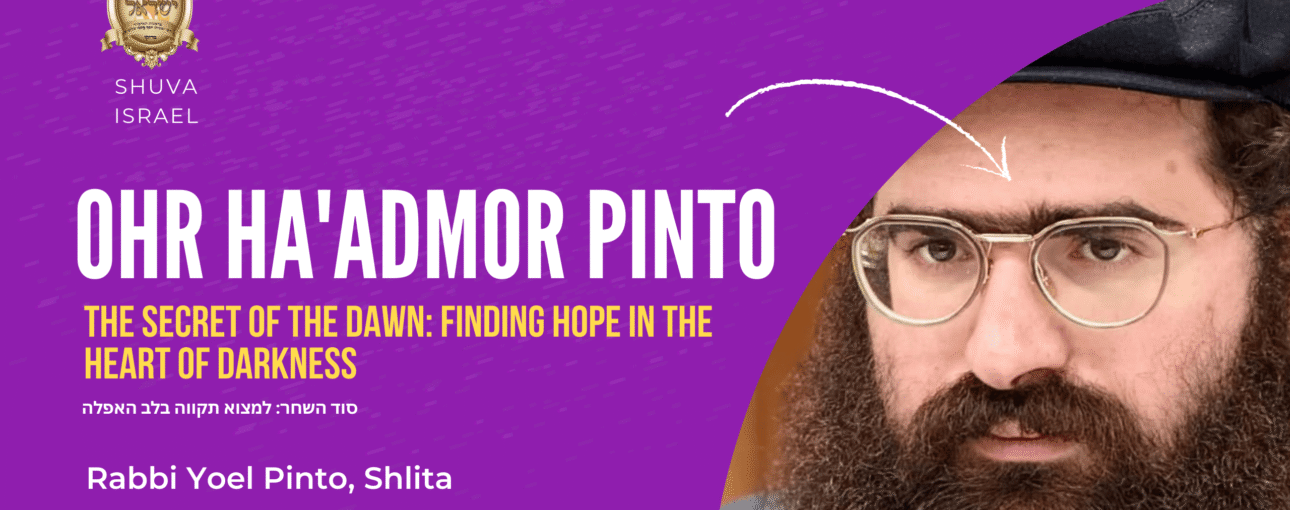
In a profound recent shiur, Rabbi Yoel Moshe Pinto explores the spiritual mechanics of hope, drawing from the tears of Rachel Imeinu, the struggles of Moshe Rabbeinu, and a surprising lesson from the morning rooster. Through these sources, we discover that redemption is not just something we wait for—it is something we prepare for by how we choose to see the “darkness” before the dawn.
Rachel Imeinu: The Power of Restraint
The Prophet Jeremiah captures a haunting scene: Rachel Imeinu weeping for her children as they are led into exile. Hashem responds with a command that seems almost impossible: “Restrain your voice from weeping and your eyes from tears… and the children shall return to their borders.”
Rabbi Pinto asks a penetrating question: Why does Hashem tell her to stop crying before the children return?
The answer lies in the nature of the decree itself. Hashem reveals to Rachel that the key to reversing the decree is the transition from despair to hope. When we are crushed by the “emotional hardship” and “mental crises” of life’s exiles, our tears can sometimes become a wall. By telling Rachel to stop her crying, Hashem was teaching her—and us—that the return to our “borders” begins the moment we believe the light is coming, even while we are still in the land of the enemy.
Moshe Rabbeinu and the “Why” of Suffering
We see a similar struggle in the life of Moshe Rabbeinu. When Moshe first went to Pharaoh to redeem Israel, things didn’t get better; they got worse. The labor became harder, and the people suffered more. In a moment of human shaking, Moshe asked Hashem: “Why have You done evil to this people?”
Rabbi Pinto explains that this wasn’t a lack of faith in Hashem’s power, but a moment of profound uncertainty. This uncertainty is the most dangerous space for a person to inhabit. We see that when the children of Israel were in the desert and Moshe didn’t descend from Sinai exactly when they expected, they panicked. That small window of “not knowing” led to the Golden Calf—the most severe sin in our history.
The lesson for us is clear: The most difficult part of any struggle isn’t the hardship itself, but the uncertainty of when it will end. Faith is the tool we use to bridge that gap.
The Wisdom of the Rooster: Seeing the Light Before it Shines
Perhaps the most beautiful insight in the shiur comes from the Birkot HaShachar (Morning Blessings). Every morning, we thank Hashem for giving the “Sechvi” (the rooster) the understanding to distinguish between night and day.
The Sages ask: Why do we praise Hashem for the rooster’s intelligence? Humans can also see when the sun rises!
Rabbi Pinto explains that the rooster’s uniqueness is not that it sees the sun, but that it sings while it is still dark. The rooster senses the “dawn rising” before the human eye can detect a single ray of light. It knows that the night is technically over even when the world is still pitch black.
This is the virtue we pray for every morning. We want to be like the Sechvi—to have the spiritual intuition to know that “soon the great light will come.”
Moving Forward with Emunah
Whether we are facing national trials or personal “Egyptian” exiles, the message of Rachel, Moshe, and the morning rooster is the same: The light is already on its way.
When we thank Hashem for the rooster, we are asking for the ability to distinguish between the darkness of a night that is ending and a night that is beginning. We are choosing to believe that our “reward exists” and that our children—our dreams, our peace, and our stability—will return to their borders.
May we all merit to hear the “voice of the rooster” in our own lives, signaling the end of our hardships and the beginning of a great, healing light.
Watch the Full Shiur:
To dive deeper into these concepts and hear the full explanation from Rabbi Yoel Moshe Pinto, watch the complete video below.
Stay connected for more Torah insights and wisdom to brighten your week.
